Max Weber
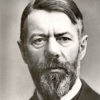
Max Weber
Karl Emil Maximilian "Max" Weberwas a German sociologist, philosopher, jurist, and political economist whose ideas profoundly influenced social theory and social research. Weber is often cited, with Émile Durkheim and Karl Marx, as among the three founders of sociology...
NationalityGerman
ProfessionPhilosopher
Date of Birth21 April 1864
CountryGermany
artist soldier acquisition
The impulse to acquisition, pursuit of gain, of money, of the greatest possible amount of money, has in itself nothing to do with capitalism. This impulse exists and has existed among waiters, physicians, coachmen, artists, prostitutes, dishonest officials, soldiers, nobles, crusaders, gamblers, and beggars.
mean distribution-of-power groups
Politics means striving to share power or striving to influence the distribution of power, either among states or among groups within a state.
thinking age months
No sociologist should think himself too good, even in his old age, to make tens of thousands of quite trivial computations in his head and perhaps for months at a time.
religious emotional class
The purely emotional form of Pietism is, as Ritschl has pointed out, a religious dilettantism for the leisure class.
strong boards boring
Politics is a strong and slow boring of hard boards.
religious world revolution
The experience of the irrationality of the world has been the driving force of all religious revolution.
men historical impossible
Certainly all historical experience confirms the truth - that man would not have attained the possible unless time and again he had reached out for the impossible.
religious sacrifice men
The capacity for the accomplishment of religious virtuosos the "intellectual sacrifice" is the decisive characteristic of the positively religious man. That this is so is shown by the fact that in spite of (or rather in consequence) of theology (which unveils it) the tension between the value-spheres of "science" and the sphere of "the holy" is unbridgeable.
men hands everyday-routine
The career of politics grants a feeling of power. The knowledge of influencing men, of participating in power over them, and above all, the feeling of holding in one's hands a nerve fiber of historically important events can elevate the professional politician above everyday routine even when he is placed in formally modest positions.
men wish doe
Man does not by nature wish to earn more and more money.
heart civilization levels
specialists without spirit, sensualists without heart; this nullity imagines that it has attained a level of civilization never before achieved.