Murray Rothbard
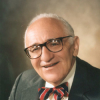
Murray Rothbard
Murray Newton Rothbardwas an American heterodox economist of the Austrian School, a revisionist historian, and a political theoristwhose writings and personal influence played a seminal role in the development of modern libertarianism. Rothbard was the founder and leading theoretician of anarcho-capitalism, a staunch advocate of historical revisionism, and a central figure in the twentieth-century American libertarian movement. He wrote over twenty books on political theory, revisionist history, economics, and other subjects. Rothbard asserted that all services provided by the "monopoly...
NationalityAmerican
ProfessionHistorian
Date of Birth2 March 1926
CountryUnited States of America
[T]he crucial question is not, as so many believe, whether property rights should be private or governmental, but rather whether the necessarily 'private' owners are legitimate owners or criminals. For ultimately, there is no entity called 'government'; there are only people forming themselves into groups called 'governments' and acting in a 'governmental' manner. All property is therefore always 'private'; the only and critical question is whether it should reside in the hands of criminals or of the proper and legitimate owners.
What do intellectuals and opinion makers get from big government? An increasing number of cushy jobs in the bureaucracy, or in the government-subsidized sector, staffing the welfare regulatory state, and apologizing for its policies, as well as propagandizing for them among the public. To put it bluntly, intellectuals, theorists, pundits, media elites, etc. get to live a life which they could not attain on the free market, but which they can gain at taxpayer expense.
It is curious that people tend to regard government as a quasi-divine, selfless, Santa Claus organization. Government was constructed neither for ability nor for the exercise of loving care; government was built for the use of force and for necessarily demagogic appeals for votes. If individuals do not know their own interests in many cases, they are free to turn to private experts for guidance. It is absurd to say that they will be served better by a coercive, demagogic apparatus.
Just as no one is morally required to answer a robber truthfully when he asks if there are any valuables in one’s house, so no one can be morally required to answer truthfully similar questions asked by the State, e.g., when filling out income tax returns.
You don't need a treaty to have free trade.
I see no other conceivable strategy for the achievement of liberty than political action. Religious or philosophical conversion of each man and woman is simply not going to work; that strategy ignores the problem of power, the fact that millions of people have a vested interest in statism and are not likely to give it up.... Education in liberty is of course vital, but it is not enough; action must also be taken to roll back the State...
It is in war that the State really comes into its own: swelling in power, in number, in pride, in absolute dominion over the economy and the society.
The great non sequitur committed by defenders of the State, is to leap from the necessity of society to the necessity of the State.
Behind the honeyed but patently absurd pleas for equality is a ruthless drive for placing themselves (the elites) at the top of a new hierarchy of power.
If you wish to know how libertarians regard the State and any of its acts, simply think of the State as a criminal band, and all of the libertarian attitudes will logically fall into place.
There is one good thing about Marx: he was not a Keynesian.
Human life is not some sort of race or game in which each person should start from an identical mark. It is an attempt by each man to be as happy as possible. And each person could not begin from the same point, for the world has not just come into being; it is diverse and infinitely varied in its parts. The mere fact that one individual is necessarily born in a different place from someone else immediately insures that his inherited opportunity cannot be the same as his neighbor's.
The diversity of mankind is a basic postulate of our knowledge of human beings. But if mankind is diverse and individuated, then how can anyone propose equality as an ideal? Every year, scholars hold Conferences on Equality and call for greater equality, and no one challenges the basic tenet. But what justification can equality find in the nature of man? If each individual is unique, how else can he be made 'equal' to others than by destroying most of what is human in him and reducing human society to the mindless uniformity of the ant heap?
Rule by the statist elite is not benign or simply a matter of who happens to be in office: it is rule by a growing army of leeches and parasites battening off the income and wealth of hard-working Americans, destroying their property, corrupting their customs and institutions, sneering at their religion.