N. Scott Momaday
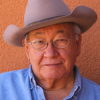
N. Scott Momaday
Navarre Scott Momaday— known as N. Scott Momaday — is a Native American author of Kiowa descent. His work House Made of Dawn was awarded the Pulitzer Prize for Fiction in 1969. Momaday received the National Medal of Arts in 2007 for his work that celebrated and preserved Native American oral and art tradition. He holds 20 honorary degrees from colleges and universities, and is a fellow of the American Academy of Arts and Sciences...
NationalityAmerican
ProfessionAuthor
Date of Birth27 February 1934
CountryUnited States of America
The Kiowas reckoned their stature by the distance they could see.
He used both hands when he made the bear. Imagine a bear proceeding from the hands of God.
In the beginning was the word, and it was spoken.
My father was a painter and he taught art. He once said to me, 'I never knew an Indian child who could not draw.'
Writing engenders in us certain attitudes toward language. It encourages us to take words for granted. Writing has enabled us to store vast quantities of words indefinitely. This is advantageous on the one hand but dangerous on the other. The result is that we have developed a kind of false security where language is concerned, and our sensitivity to language has deteriorated. And we have become in proportion insensitive to silence.
Words were medicine; they were magic and invisible. They came from nothing into sound and meaning. They were beyond price; they could neither be bought nor sold.
I sometimes think the contemporary white American is more culturally deprived than the Indian.
The character of the landscape changes from hour to hour, day to day, season to season. Nothing of the earth can be taken for granted; you feel that Creation is going on in your sight. You see things in the high air that you do not see farther down in the lowlands. In the high country all objects bear upon you, and you touch hard upon the earth. From my home I can see the huge, billowing clouds; they draw close upon me and merge with my life.
It's a landscape that has to be seen to be believed. And as I say on occasion, it may have to be believed in order to be seen.
Once in his life a man ought to concentrate his mind upon the remembered earth. He ought to give himself up to a particular landscape in his experience; to look at it from as many angles as he can, to wonder upon it, and dwell upon it.
Indians are marvelous storytellers. In some ways, that oral tradition is stronger than the written tradition.
For the storyteller, for the arrowmaker, language does indeed represent the only chance for survival.
The highest human purpose is always to reinvent and celebrate the sacred.
The first word gives origin to the second, the first and second to the third, and the third to the fourth, and so on. You cannot begin with the second word...