Nhat Hanh
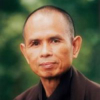
Nhat Hanh
Thích Nhất Hạnh; born as Nguyen Xuan Bao on October 11, 1926) is a Vietnamese Buddhist monk and peace activist. He lives in Plum Village in the Dordogne region in the south of France, travelling internationally to give retreats and talks. He coined the term "Engaged Buddhism" in his book Vietnam: Lotus in a Sea of Fire. A long-term exile, he was given permission to make his first return trip to Vietnam in 2005...
NationalityVietnamese
ProfessionActivist
Date of Birth11 October 1926
CountryVietnam
Life is available only in the present moment.
Meditation is not to escape from society, but to come back to ourselves and see what is going on. Once there is seeing, there must be acting. With mindfulness, we know what to do and what not to do to help.
Aware of the suffering caused by the destruction of life, I am committed to cultivating compassion and learning ways to protect the lives of people, animals, plants, and minerals. I am determined not to kill, not to let others kill, and not to support any act of killing in the world, in my thinking, and in my way of life.
Every path, every street in the world is your walking meditation path.
Meditation can help us embrace our worries, our fear, our anger; and that is very healing. We let our own natural capacity of healing do the work.
Words and thoughts concerning compassionate action that are not put into practice are like beautiful flowers that are colorful but have no fragrance.
Meditation is not passive sitting in silence. It is sitting in awareness, free from distraction, and realizing the clear understanding that arises from concentration.
To reconcile conflicting parties, we must have the ability to understand the suffering of both sides. If we take sides, it is impossible to do the work of reconciliation. And humans want to take sides. That is why the situation gets worse and worse. Are there people who are still available to both sides? They need not do much. They need do only one thing: Go to one side and tell all about the suffering endured by the other side, and go to the other side and tell all about the suffering endured by this side. This is our chance for peace. But how many of us are able to do that?
You can use your life in a very useful and intelligent way. You can very well transform that negative energy into a positive energy that empowers you and makes life meaningful.
We can help many people suffer less and realize a lot of happiness without being rich or influential. If love and compassion are in out hearts, every thought, word, and deed can bring about a miracle
First, let us light the torch of our awareness and learn again how to drink tea, eat, wash dishes, walk, sit, drive, and work in awareness. We do not have to be swept along by circumstances. We are not just a leaf or a log in a rushing river. With awareness, each of our daily acts takes on a new meaning, and we discover that we are more than machines, that our activities are not just mindless repetitions. We find that life is a miracle, the universe is a miracle, and we too are a miracle.
As long as you find something beautiful, good, and true to believe in and abide by, you have the equivalent of God in your life.
A look filled with understanding, an accepting smile, a loving word, a meal shared in warmth and awareness are the things which create happiness in the present moment. By nourishing awareness in the present moment, you can avoid causing suffering to yourself and those around you. The way you look at others, your smile, and your small acts of caring can create happiness. True happiness does not depend on wealth or fame.
We humans think we are smart, but an orchid, for example, knows how to produce noble, symmetrical flowers, and a snail knows how to make a beautiful, well-proportioned shell. Compared with their knowledge, ours is not worth much at all. We should bow deeply before the orchid and the snail and join our palms reverently before the monarch butterfly and the magnolia tree. The feeling of respect for all species will help us recognize the noblest nature in ourselves.