Nhat Hanh
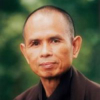
Nhat Hanh
Thích Nhất Hạnh; born as Nguyen Xuan Bao on October 11, 1926) is a Vietnamese Buddhist monk and peace activist. He lives in Plum Village in the Dordogne region in the south of France, travelling internationally to give retreats and talks. He coined the term "Engaged Buddhism" in his book Vietnam: Lotus in a Sea of Fire. A long-term exile, he was given permission to make his first return trip to Vietnam in 2005...
NationalityVietnamese
ProfessionActivist
Date of Birth11 October 1926
CountryVietnam
Feelings, whether of compassion or irritation, should be welcomed, recognized, and treated on an absolutely equal basis; because both are ourselves. The tangerine I am eating is me. The mustard greens I am planting are me. I plant with all my heart and mind. I clean this teapot with the kind of attention I would have were I giving the baby Buddha or Jesus a bath. Nothing should be treated more carefully than anything else. In mindfulness, compassion, irritation, mustard green plant, and teapot are all sacred.
A bodhisattva doesn't have to be perfect. Anyone who is aware of what is happening and who tries to wake up other people is a bodhisattva. We are all bodhisattvas, doing our best.
Keeping your body healthy is an expression of gratitude to the whole cosmos — the trees, the clouds, everything.
Listening is a very deep practice. You have to empty yourself. You have to leave space in order to listen especially to people we think are our enemies - the ones we believe are making our situation worse. When you have shown your capacity for listening and understanding, the other person will begin to listen to you, and you have a change to tell him or her of your pain, and it's your turn to be healed. This is the practice of peace.
The present moment is the substance with which the future is made. Therefore, the best way to take care of the future is to take care of the present moment. What else can you do?
Awareness is like the sun. When it shines on things, they are transformed.
You accept that this civilisation could be abolished and life will begin later on after a few thousand years because that is something that has happened in the history of this planet. When you have peace in yourself and accept, then you are calm enough to do something, but if you are carried by despair there is no hope.
When you say something really unkind, when you do something in retaliation your anger increases. You make the other person suffer, and he will try hard to say or to do something back to get relief from his suffering. That is how conflict escalates.
The situation the Earth is in today has been created by unmindful production and unmindful consumption. We consume to forget our worries and our anxieties. Tranquilising ourselves with over-consumption is not the way.
The more compassionate you are, the more generous you can be. The more generous you are, the move loving friendliness you cultivate to help the world.
The essence of love and compassion is understanding, the ability to recognize the physical, material, and psychological suffering of others, to put ourselves "inside the skin" of the other. We "go inside" their body, feelings, and mental formations, and witness for ourselves their suffering. Shallow observation as an outsider is not enough to see their suffering. We must become one with the subject of our observation. When we are in contact with another's suffering, a feeling of compassion is born in us. Compassion means, literally, "to suffer with."
Most of us experience a life full of wonderful moments and difficult moments. But for many of us, even when we are most joyful, there is fear behind our joy.
Only your compassion and your loving kindness are invincible, and without limit.
The essence of nonviolence is love. Out of love and the willingness to act selflessly, strategies, tactics, and techniques for a nonviolent struggle arise naturally. Nonviolence is not a dogma; it is a process.