Nhat Hanh
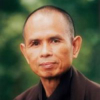
Nhat Hanh
Thích Nhất Hạnh; born as Nguyen Xuan Bao on October 11, 1926) is a Vietnamese Buddhist monk and peace activist. He lives in Plum Village in the Dordogne region in the south of France, travelling internationally to give retreats and talks. He coined the term "Engaged Buddhism" in his book Vietnam: Lotus in a Sea of Fire. A long-term exile, he was given permission to make his first return trip to Vietnam in 2005...
NationalityVietnamese
ProfessionActivist
Date of Birth11 October 1926
CountryVietnam
People usually consider walking on water or in thin air a miracle. But I think the real miracle is not to walk either on water or in thin air, but to walk on earth. Every day we are engaged in a miracle which we don't even recognize: a blue sky, white clouds, green leaves, the black, curious eyes of a child -- our own two eyes. All is a miracle.
Waking up this morning, I smile. Twenty-four brand new hours are before me. I vow to live fully in each moment and to look at all beings with eyes of compassion.
Buddhism is in your heart. Even if you don't have any temple or any monks, you can still be a Buddhist in your heart and life.
One day I saw a picture of the Buddha on a Buddhist magazine and he was sitting on the grass, and he was sitting on the grass, very peaceful, smiling, and I was impressed. Around me people were not like that, so I had the desire to be someone like him. I nourished that kind of desire until the age of sixteen, when I had the permission from my parents to go and ordain as a Buddhist monk.
During the last 2,500 years in Buddhist monasteries, a system of seven practices of reconciliation has evolved. Although these techniques were formulated to settle disputes within the circle of monks, i think they might also be of use in our households and in our society.The first practice is Face-to-Face-Sitting.
In Buddhist culture, offering food to the monk symbolizes the action of goodness, and if you have no opportunity to support the practice of spirituality, then you are somehow left in the realm of darkness.
If you're a politician, you might want to learn the Buddhist way of negotiation. Restoring communication and bringing back reconciliation is clear and concrete in Buddhism.
If we are not empty, we become a block of matter. We cannot breathe, we cannot think. To be empty means to be alive, to breathe in and to breathe out. We cannot be alive if we are not empty. Emptiness is impermanence, it is change. We should not complain about impermanence, because without impermanence, nothing is possible.
In Buddhism, mindfulness is the key. Mindfulness is the energy that sheds light on all things and all activities, producing the power of concentration, bringing forth deep insight and awakening. Mindfulness is the base of Buddhist practice
The secret of Buddhism is to remove all ideas, all concepts, in order for the truth to have a chance to penetrate, to reveal itself.
When we come into contact with the other person, our thoughts and actions should express our mind of compassion, even if that person says and does things that are not easy to accept. We practice in this way until we see clearly that our love is not contingent upon the other person being lovable.
The seed of suffering in you may be strong, but don't wait until you have no more suffering before allowing yourself to be happy.
Through my love for you, I want to express my love for the whole cosmos, the whole of humanity, and all beings. By living with you, I want to learn to love everyone and all species. If I succeed in loving you, I will be able to love everyone and all species on Earth... This is the real message of love.
Your breathing should flow gracefully, like a river, like a watersnake crossing the water, and not like a chain of rugged mountains or the gallop of a horse. To master our breath is to be in control of our bodies and minds. Each time we find ourselves dispersed and find it difficult to gain control of ourselves by different means, the method of watching the breath should always be used.