Nhat Hanh
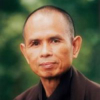
Nhat Hanh
Thích Nhất Hạnh; born as Nguyen Xuan Bao on October 11, 1926) is a Vietnamese Buddhist monk and peace activist. He lives in Plum Village in the Dordogne region in the south of France, travelling internationally to give retreats and talks. He coined the term "Engaged Buddhism" in his book Vietnam: Lotus in a Sea of Fire. A long-term exile, he was given permission to make his first return trip to Vietnam in 2005...
NationalityVietnamese
ProfessionActivist
Date of Birth11 October 1926
CountryVietnam
Because if the manifestations that happen in the present moment are beautiful and good, their continuation in the future will be also good and beautiful.
When you are a young person, you are like a young creek, and you meet many rocks, many obstacles and difficulties on your way. You hurry to get past these obstacles and get to the ocean. But as the creek moves down through the fields, it becomes larges and calmer and it can enjoy the reflection of the sky. It's wonderful. You will arrive at the sea anyway so enjoy the journey. Enjoy the sunshine, the sunset, the moon, the birds, the trees, and the many beauties along the way. Taste every moment of your daily life.
Do we need to make a special effort to enjoy the beauty of the blue sky? Do we have to practice to be able to enjoy it? No, we just enjoy it. Each second, each minute of our lives can be like this. Wherever we are, any time, we have the capacity to enjoy the sunshine, the presence of each other, even the sensation of our breathing. We don't need to go to China to enjoy the blue sky. We don't have to travel into the future to enjoy our breathing. We can be in touch with these things right now.
Every day we touch what is wrong, and, as a result, we are becoming less and less healthy. That is why we have to learn to practice touching what is not wrong—inside us and around us. When we get in touch with our eyes, our heart, our liver, our breathing, and our non-toothache and really enjoy them, we see that the conditions for peace and happiness are already present.
Many Communist government officials have a rigid, dictatorial power, but they live in constant suspicion and fear of anything that might undermine the power they have.
In Buddhist culture, offering food to the monk symbolizes the action of goodness, and if you have no opportunity to support the practice of spirituality, then you are somehow left in the realm of darkness.
Mindfulness must be engaged. Once there is seeing, there must be acting. Otherwise, what's the use of seeing?
We fear that this moment will end, that we won't get what we need, that we will lose what we love, or that we will not be safe. Often, our biggest fear is the knowledge that one day our bodies will cease functioning. So even when we are surrounded by all the conditions for happiness, our joy is not complete.
If we chew every morsel of our food, in that way we become grateful, and when you are grateful, you are happy.
The electron is first of all your concept of the electron.
I have lost my smile, but don't worry. The dandelion has it.
The bad things, don't do them. The good things, try to do them. Try to purify, subdue your own mind. That is the teaching of all buddhas.
If you're a politician, you might want to learn the Buddhist way of negotiation. Restoring communication and bringing back reconciliation is clear and concrete in Buddhism.
If you have the insight of non-self, if you have the insight of impermanence, you should make that insight into a concentration that you keep alive throughout the day. Then what you say, what you think, and what you do will then be in the light of that wisdom and you will avoid making mistakes and creating suffering.