Noam Chomsky
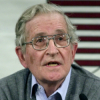
Noam Chomsky
Avram Noam Chomskyis an American linguist, philosopher, cognitive scientist, historian, logician, social critic, and political activist. Sometimes described as "the father of modern linguistics", Chomsky is also a major figure in analytic philosophy, and one of the founders of the field of cognitive science. He has spent more than half a century at the Massachusetts Institute of Technology, where he is Institute Professor Emeritus, and is the author of over 100 books on topics such as linguistics, war, politics, and...
NationalityAmerican
ProfessionTeacher
Date of Birth7 December 1928
CityPhiladelphia, PA
CountryUnited States of America
The Great Seal was an early proclamation of 'humanitarian intervention,' to use the currently fashionable phrase.
Anarchism means all sort of things to different people, but the traditional anarchists' movements assumed that there'd be a highly organized society, just one organized from below with direct participation and so on.
The list of U.S. vetoes at the Security Council to protect Israeli aggression and occupation is huge.
Two days after the Boston marathon bombings, there was a drone strike in Yemen attacking a peaceful village, which killed a target who could very easily have been apprehended. But, of course, it is just easier to terrorise people. The drones are a terrorist weapon; they not only kill targets but also terrorise other people.
International affairs is very much run like the mafia. The godfather does not accept disobedience, even from a small storekeeper who doesn't pay his protection money. You have to have obedience; otherwise, the idea can spread that you don't have to listen to the orders, and it can spread to important places.
It is easy to dismiss the world as 'irrelevant,' or consumed by 'paranoid anti-Americanism,' but perhaps not wise.
Changes and progress very rarely are gifts from above. They come out of struggles from below.
Even in the 1950s, President Eisenhower was concerned about what he called a campaign of hatred of the U.S. in the Arab world, because of the perception on the Arab street that it supported harsh and oppressive regimes to take their oil.
By curious accident of history and geography, the world's major energy resources are located pretty much in Shiite regions. They're a minority in the Middle East, but they happen to be where the oil is, right around the northern part of the Gulf.
When George W. Bush came into office, North Korea had maybe one nuclear weapon and verifiably wasn't producing any more.
In the United States, one of the main topics of academic political science is the study of attitudes and policy and their correlation. The study of attitudes is reasonably easy in the United States: heavily-polled society, pretty serious and accurate polls, and policy you can see, and you can compare them.
I don't know if I officially proofread my father's book, but I read it. I did get some conception of grammar in general from that.
The Oslo Accords in 1993 determined that the Gaza Strip and the West Bank are a single territorial entity which cannot be divided. Immediately, the United States and Israel set about separating the two and making sure that they would not be united.
I stated that Hiroshima and Nagasaki are 'among the most unspeakable crimes in history.' I took no position on just where they stand on the scale of horrors relative to Auschwitz, the bombing of Chungking, Lidice, and so on.