Plutarch
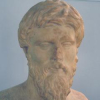
Plutarch
Plutarch; c. AD 46 – AD 120) was a Greek historian, biographer, and essayist, known primarily for his Parallel Lives and Moralia. He is classified as a Middle Platonist. Plutarch's surviving works were written in Greek, but intended for both Greek and Roman readers...
NationalityGreek
ProfessionPhilosopher
people opinion said
Once when Phocion had delivered an opinion which pleased the people,... he turned to his friend and said, "Have I not unawares spoken some mischievous thing or other?
sweet medicine fire
A human body in no way resembles those that were born for ravenousness; it hath no hawk's bill, no sharp talon, no roughness of teeth, no such strength of stomach or heat of digestion, as can be sufficient to convert or alter such heavy and fleshy fare . . . There is nobody that is willing to eat even a lifeless and a dead thing even as it is; so they boil it, and roast it, and alter it by fire and medicines, as it were, changing and quenching the slaughtered gore with thousands of sweet sauces, that the palate being thereby deceived may admit of such uncouth fare.
men hands envy
For the rich men without scruple drew the estate into their own hands, excluding the rightful heirs from their succession; and all the wealth being centred upon the few, the generality were poor and miserable. Honourable pursuits, for which there was no longer leisure, were neglected; the state was filled with sordid business, and with hatred and envy of the rich.
mean understanding meanings-of-words
For it was not so much that by means of words I came to a complete understanding of things, as that from things I somehow had an experience which enabled me to follow the meaning of words.
lying speech figures
Speech is like cloth of Arras opened and put abroad, whereby the imagery doth appear in figure; whereas in thoughts they lie but as packs.
art voice body
A Locanian having plucked all the feathers off from a nightingale and seeing what a little body it had, "surely," quoth he, "thou art all voice and nothing else.
men spokes mets
Spintharus, speaking in commendation of Epaminondas, says he scarce ever met with any man who knew more and spoke less.
men good-man battle
Epaminondas is reported wittily to have said of a good man that died about the time of the battle of Leuctra, "How came he to have so much leisure as to die, when there was so much stirring?
art succeed doe
It does not follow, that because a particular work of art succeeds in charming us, its creator also deserves our admiration.
From Themistocles began the saying, "He is a second Hercules.
men voice light
I, for my part, wonder of what sort of feeling, mind or reason that man was possessed who was first to pollute his mouth with gore, and to allow his lips to touch the flesh of a murdered being: who spread his table with the mangled forms of dead bodies, and claimed as daily food and dainty dishes what but now were beings endowed with movement, perception and with voice. …but for the sake of some little mouthful of flesh, we deprive a soul of the sun and light, and of that portion of life and time it had been born in to the world to enjoy.
people might shields
Such power I gave the people as might do, Abridged not what they had, now lavished new, Those that were great in wealth and high in place My counsel likewise kept from all disgrace. Before them both I held my shield of might, And let not either touch the other's right.
may gains strange
The process may seem strange and yet it is very true. I did not so much gain the knowledge of things by the words, as words by the experience I had of things.
may
That we may consult concerning others, and not others concerning us.