Rabindranath Tagore
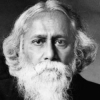
Rabindranath Tagore
Rabindranath Tagore FRAS, also written Ravīndranātha Thākura, sobriquet Gurudev, was a Bengali polymath who reshaped Bengali literature and music, as well as Indian art with Contextual Modernism in the late 19th and early 20th centuries. Author of Gitanjali and its "profoundly sensitive, fresh and beautiful verse", he became the first non-European to win the Nobel Prize in Literature in 1913. In translation his poetry was viewed as spiritual and mercurial; however, his "elegant prose and magical poetry" remain largely unknown...
NationalityIndian
ProfessionPoet
Date of Birth7 May 1861
CityKolkata, India
CountryIndia
Life's aspirations come in the guise of children.
If it is necessary to die in order to live like men, what harm in dying?
It dances today, my heart, like a peacock it dances, it dances. It sports a mosaic of passions like a peacock’s tail, It soars to the sky with delight, it quests, Oh wildly, it dances today, my heart, like a peacock it dances.
The soil in return for her service keeps the tree tied to her, the sky asks nothing and leaves it free.
He only has freedom who ideally loves freedom himself and is glad to extend it to others. He who cares to have slaves must chain himself to them. He who builds walls to create exclusion for others builds walls across his own freedom. He who distrusts freedom in others loses his moral right to it.
At the immortal touch of thy hands my little heart loses its limits in joy and gives birth to utterance ineffable.
The speech of my heart will be carried on in murmurings of a song.
When you have once taken up a responsibility, you must see it through.
The music of the far-away summer flutters around the Autumn seeking its former nest.
Religion, like poetry, is not a mere idea, it is expression. The self-expression of God is in the endless variety of creation; and our attitude toward the Infinite Being must also in its expression have a variety of individuality ceaseless and unendi.
Our scientific world is our world of reasoning. It has its greatness and uses and attractions. We are ready to pay homage due to it. But when it claims to have discovered the real world for us and laughs at the worlds of all simple-minded men, then we must say it is like a general grown intoxicated with his power, usurping the throne of his king
It is the same life that emerges in joy through the dust of the earth into numberless waves of flower.
When we accept any discipline for ourselves, we try to avoid everything except that which is necessary for our purpose; it is this purposefulness, which belongs to the adult mind, that we force upon school children. We say, "Never keep your mind aler.
The water vessel, taken as a vessel only, raises the question, "Why does it exist at all?" Through its fitness of construction, it offers the apology for its existence. But where it is a work of beauty it has no question to answer; it has nothing to do, but to be.