Rabindranath Tagore
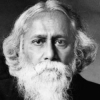
Rabindranath Tagore
Rabindranath Tagore FRAS, also written Ravīndranātha Thākura, sobriquet Gurudev, was a Bengali polymath who reshaped Bengali literature and music, as well as Indian art with Contextual Modernism in the late 19th and early 20th centuries. Author of Gitanjali and its "profoundly sensitive, fresh and beautiful verse", he became the first non-European to win the Nobel Prize in Literature in 1913. In translation his poetry was viewed as spiritual and mercurial; however, his "elegant prose and magical poetry" remain largely unknown...
NationalityIndian
ProfessionPoet
Date of Birth7 May 1861
CityKolkata, India
CountryIndia
The mountain remains unmoved at seeming defeat by the mist.
O master poet, I have sat down at thy feet. Only let me make my life simple and straight, like a flute of reed for thee to fill with music.
Life is perpetually creative because it contains in itself that surplus which ever overflows the boundaries of the immediate time and space, restlessly pursuing its adventure of expression in the varied forms of self-realization.
I have on my table a violin string. It is free to move in any direction I like. If I twist one end, it responds; it is free. But it is not free to sing. So I take it and fix it into my violin. I bind it and when it is bound, it is free for the first time to sing.
Oh my only friend, my best beloved, the gates are open in my house—do not pass by like a dream.
Perhaps the new dawn will come from this horizon, from the East where the sun rises; and then, unvanquished Man will retrace his path of conquest, despite all barriers, to win back his lost heritage.
Brahma was excessively sparing with earth, water, and fire.... The reckless expenditure of air and ether in his composition was amazing. And, in consequence, he perpetually struggled to outreach the wind, to outrun space itself. Other animals ran only when they had a reason, but the Horse would run for no reason whatever, as if to run out of his own skin.
Power said to the world, "You are mine." The world kept it prisoner on her throne. Love said to the world, "I am thine." The world gave it the freedom of her house.
Where is heaven? you ask me, my child,-the sages tell us it is beyond the limits of birth and death, unswayed by the rhythm of day and night; it is not of the earth. But your poet knows that its eternal hunger is for time and space, and it strives evermore to be born in the fruitful dust. Heaven is fulfilled in your sweet body, my child, in your palpitating heart. The sea is beating its drums in joy, the flowers are a-tiptoe to kiss you. For heaven is born in you, in the arms of the mother- dust.
Truth looks tawdry when she is overdressed.
My debts are large, my failures great, my shame secret and heavy; yet I come to ask for my good, I quake in fear lest my prayer be granted.
What you are you do not see, what you see is your shadow.
Whatever we understand and enjoy in human products instantly becomes ours, wherever they might have their origin... Let me feel with unalloyed gladness that all the great glories of man are mine.
Grant me that I may not be a coward, feeling your mercy in my success alone; but let me find the grasp of your hand in my failure.