Rabindranath Tagore
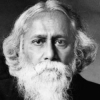
Rabindranath Tagore
Rabindranath Tagore FRAS, also written Ravīndranātha Thākura, sobriquet Gurudev, was a Bengali polymath who reshaped Bengali literature and music, as well as Indian art with Contextual Modernism in the late 19th and early 20th centuries. Author of Gitanjali and its "profoundly sensitive, fresh and beautiful verse", he became the first non-European to win the Nobel Prize in Literature in 1913. In translation his poetry was viewed as spiritual and mercurial; however, his "elegant prose and magical poetry" remain largely unknown...
NationalityIndian
ProfessionPoet
Date of Birth7 May 1861
CityKolkata, India
CountryIndia
The man who aims at his own aggrandisement underrates everything else.
The fountain of death makes the still waters of life play.
The current of the world has its boundaries, otherwise it could have no existence, but its purpose is not shown in the boundaries which restrain it, but in its movement, which is toward perfection. The wonder is not that there should be obstacles and
The man whose acquaintance with the world does not lead him deeper than science leads him, will never understand what it is that the man with the spiritual vision finds in these natural phenomena. The water does not merely cleanse his limbs, but it p
All men have poetry in their hearts, and it is necessary for them, as much as possible, to express their feelings. For this they must have a medium, moving and pliant, which can refreshingly become their own, age after age. All great languages undergo change. Those languages which resist the spirit of change are doomed and will never produce great harvests of thought and literature. When forms become fixed, the spirit either weakly accepts its imprisonment or rebels. All revolutions consists of the "within" fighting against invasion from "without"... All great human movements are related to some great idea.
The emancipation of our physical nature is in attaining health, of our social being in attaining goodness, and of our self in attaining love.
A mind all logic is like a knife all blade.
I have become my own version of an optimist. If I can't make it through one door, I'll go through another door - or I'll make a door. Something terrific will come no matter how dark the present.
It is our desires that limit the scope of our self-realization, hinder our extension of consciousness, and give rise to sin, which is the innermost barrier that keeps us apart from our God, setting up disunion and arrogance of exclusiveness. For sin
Music is the purest form of art, and therefore the most direct expression of beauty, with a form and spirit which is one and simple, and least encumbered with anything extraneous. We seem to feel that the manifestation of the infinite in the finite forms of creation is music itself, silent and visible.
The object of education is to give man the unity of truth. Formerly, when life was simple, all the different elements of man were in complete harmony. But when there came the separation of the intellect from the spiritual and the physical, the school
In Art, man reveals himself and not his objects.
And it shall be my endeavour to reveal thee in my actions, knowing it is thy power gives me strength to act.
The best of us still have our aspirations for the supreme goals of life, which is so often mocked by prosperous people who now control the world. We still believe that the world has a deeper meaning than what is apparent, and that therein the human s