Samuel Johnson
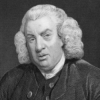
Samuel Johnson
Samuel Johnson, often referred to as Dr Johnson, was an English writer who made lasting contributions to English literature as a poet, essayist, moralist, literary critic, biographer, editor and lexicographer. Johnson was a devout Anglican and committed Tory, and has been described as "arguably the most distinguished man of letters in English history". He is also the subject of "the most famous single biographical work in the whole of literature," James Boswell's Life of Samuel Johnson...
NationalityEnglish
ProfessionNon-Fiction Author
Date of Birth18 September 1709
That the happiness of man may still remain imperfect, as wants in this place are easily supplied, new wants likewise are easily created; every man, in surveying the shops of London, sees numberless instruments and conveniencies, of which, while he did not know them, he never felt the need; and yet, when use has made them familiar, wonders how life could be supported without them. Thus it comes to pass, that our desires always increase with our possessions; the knowledge that something remains yet unenjoyed, impairs our enjoyment of the good before us.
All knowledge is of itself of some value. There is nothing so minute or inconsiderable, that I would not rather know it than not. In the same manner, all power, of whatever sort, is of itself desirable. A man would not submit to learn to hem a ruffle, of his wife, or his wife's maid; but if a mere wish could attain it, he would rather wish to be able to hem a ruffle.
Persius has justly observed, that knowledge is nothing to him who is not known by others to possess it: to the scholar himself it is nothing with respect either to honour or advantage, for the world cannot reward those qualities which are concealed from it; with respect to others it is nothing, because it affords no help to ignorance or errour.
To understand the works of celebrated authors, to comprehend their systems, and retain their reasonings, is a task more than equal to common intellects; and he is by no means to be accounted useless or idle, who has stored his mind with acquired knowledge, and can detail it occasionally to others who have less leisure or weaker abilities.
Every man has something to do which he neglects, every man has faults to conquer which he delays to combat.
Critics ought never to be consulted, but while errors may yet be rectified or insipidity suppressed. But when the book has once been dismissed into the world, and can be no more retouched, I know not whether a very different conduct should not be prescribed, and whether firmness and spirit may not sometimes be of use to overpower arrogance and repel brutality.
Let him that desires to see others happy, make haste to give while his gift can be enjoyed, and remember that every moment of delay takes away something from the value of his benefaction.
Every one should consider himself as intrusted not only with his own conduct, but with that of others; and as accountable, not only for the duties which he neglects, or the crimes that he commits, but for that negligence and irregularity which he may encourage or inculcate. Every man, in whatever station, has, or endeavours to have his followers, admirers, and imitators, and has therefore the influence of his example to watch with care.
As all error is meanness, it is incumbent on every man who consults his own dignity, to retract it as soon as he discovers it.
I cannot forbear to wish, that this commotion (in the colonies) may end without bloodshed, and that the rebels may be subdued by terror rather than by violence; and, therefore, recommend such a force as may take away, not only the power, but the hope
Celestial wisdom calms the mind.
If he really thinks there is no distinction between vice and virtue, when he leaves our houses let us count our spoons.
Age is rarely despised but when it is, contemptible.
Every state of society is as luxurious as it can be. Men always take the best they can get.