Slavoj Zizek
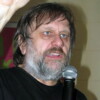
Slavoj Zizek
Slavoj Žižek; born 21 March 1949) is a Slovenian psychoanalytic philosopher, cultural critic, and Hegelian Marxist. He is a senior researcher at the Institute for Sociology and Philosophy at the University of Ljubljana, Global Distinguished Professor of German at New York University, and international director of the Birkbeck Institute for the Humanities of the University of London. His work is located at the intersection of a range of subjects, including continental philosophy, political theory, cultural studies, psychoanalysis, film criticism, and...
ProfessionPhilosopher
Date of Birth21 March 1949
The problem for us is not are our desires satisfied or not. The problem is how do we know what we desire.
If you have reasons to love someone, you don’t love them.
Atheism is not the denial of the existence of God, but having doubts as to whether God is conscious.
Think about the strangeness of today's situation. Thirty, forty years ago, we were still debating about what the future will be: communist, fascist, capitalist, whatever. Today, nobody even debates these issues. We all silently accept global capitalism is here to stay. On the other hand, we are obsessed with cosmic catastrophes: the whole life on earth disintegrating, because of some virus, because of an asteroid hitting the earth, and so on. So the paradox is, that it's much easier to imagine the end of all life on earth than a much more modest radical change in capitalism.
The threat today is not passivity, but pseudo-activity, the urge to "be active", to "participate", to mask the Nothingness of what goes on.
What if the way we perceive a problem is already part of the problem?
Love feels like a great misfortune, a monstrous parasite, a permanent state of emergency that ruins all small pleasures.
The horror of Communism, Stalinism, is not that bad people do bad things -- they always do. It's that good people do horrible things thinking they are doing something great.
Words are never 'only words'; they matter because they define the contours of what we can do.
Thinking begins when you ask really difficult questions.
On the information sheet in a New York hotel, I recently read: 'Dear guest! To guarantee that you will fully enjoy your stay with us, this hotel is totally smoke-free. For any infringement of this regulation, you will be charged $200.' The beauty of this formulation, taken literally, is that you are to be punished for refusing to fully enjoy your stay.
We have all the freedoms we want. But what we are missing is red ink: the language to articulate our non-freedom. The way we are taught to speak about freedom- war on terror and so on-falsifies freedom.
I think Kafka was right when he said that for a modern, secular, nonreligious man, state bureaucracy is the only remaining contact with the dimension of the divine; the impenetrable omnipotence of bureaucracy harbors is divine enjoyment. It is the performance of its very purposelessness that generates an intense enjoyment, ready to reproduce itself forever.
I believe in clear-cut positions. I think that the most arrogant position is this apparent, multidisciplinary modesty of "what I am saying now is not unconditional, it is just a hypothesis," and so on. It really is a most arrogant position. I think that the only way to be honest and expose yourself to criticism is to state clearly and dogmatically where you are. You must take the risk and have a position.