Soren Kierkegaard
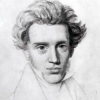
Soren Kierkegaard
Søren Aabye Kierkegaard; 5 May 1813 – 11 November 1855) was a Danish philosopher, theologian, poet, social critic and religious author who is widely considered to be the first existentialist philosopher. He wrote critical texts on organized religion, Christendom, morality, ethics, psychology, and the philosophy of religion, displaying a fondness for metaphor, irony and parables. Much of his philosophical work deals with the issues of how one lives as a "single individual", giving priority to concrete human reality over abstract thinking...
NationalityDanish
ProfessionPhilosopher
Date of Birth5 May 1813
CityCopenhagen, Denmark
CountryDenmark
Soren Kierkegaard quotes about
Christ was crucified because he would have nothing to do with the crowd (even though he addressed himself to all). He did not want to form a party, an interest group, a mass movement, but wanted to be what he was, the truth, which is related to the single individual. Therefore everyone who will genuinely serve the truth is by that very fact a martyr. To win a crowd is no art; for that only untruth is needed, nonsense, and a little knowledge of human passions. But no witness to the truth dares to get involved with the crowd.
The greatest danger to Christianity is, I contend, not heresies, not heterodoxies, not atheists, not profane secularism - no, but the kind of orthodoxy which is cordial drivel, mediocrity served up sweet. There is nothing that so insidiously displaces the majestic as cordiality.
Truth has always had many loud proclaimers, but the question is whether a person will in the deepest sense acknowledge the truth, allow it to permeate his whole being, accept all its consequences, and not have an emergency hiding place for himself and a Judas kiss for the consequence.
Christ has not only spoken to us by his life but has also spoken for us by his death.
A man prayed, and at first he thought that prayer was talking. But he became more and more quiet until in the end he realized prayer is listening.
Once you label me you negate me.
For without risk there is no faith, and the greater the risk, the greater the faith.
Above all, do not lose your desire to walk. Everyday, I walk myself into a state of well-being & walk away from every illness. I have walked myself into my best thoughts, and I know of no thought so burdensome that one cannot walk away from it. But by sitting still, & the more one sits still, the closer one comes to feeling ill. Thus if one just keeps on walking, everything will be all right.
Truth always rests with the minority, and the minority is always stronger than the majority, because the minority is generally formed by those who really have an opinion, while the strength of a majority is illusory, formed by the gangs who have no opinion — and who, therefore, in the next instant (when it is evident that the minority is the stronger) assume its opinion… while truth again reverts to a new minority.
Life can only be understood backwards; but it must be lived forwards.
There are two ways to be fooled. One is to believe what isn't true; the other is to refuse to believe what is true.
A man may perform astonishing feats and comprehend a vast amount of knowledge, and yet have no understanding of himself. But suffering directs a man to look within. If it succeeds, then there, within him, is the beginning of his learning.
It is intelligent to ask two questions: (1) Is it possible? (2) Can I do it?. But it is unintelligent to ask these questions: (1) Is it real? (2) Has my neighbor done it?
Man is spirit. But what is spirit? Spirit is the self. But what is the self? The self is a relation which relates itself to itself... Man is a synthesis of the infinite and the finite, of the temporal and the eternal, of possibility and necessity, in short, it is a synthesis. A synthesis is a relation between two factors. So regarded, man is not yet a self.