Soren Kierkegaard
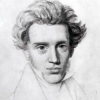
Soren Kierkegaard
Søren Aabye Kierkegaard; 5 May 1813 – 11 November 1855) was a Danish philosopher, theologian, poet, social critic and religious author who is widely considered to be the first existentialist philosopher. He wrote critical texts on organized religion, Christendom, morality, ethics, psychology, and the philosophy of religion, displaying a fondness for metaphor, irony and parables. Much of his philosophical work deals with the issues of how one lives as a "single individual", giving priority to concrete human reality over abstract thinking...
NationalityDanish
ProfessionPhilosopher
Date of Birth5 May 1813
CityCopenhagen, Denmark
CountryDenmark
Soren Kierkegaard quotes about
Reflection is not the evil; but a reflective condition and the deadlock which it involves, by transforming the capacity for action into a means of escape from action, is both corrupt and dangerous, and leads in the end to a retrograde movement.
People understand me so poorly that they don't even understand my complaint about them not understanding me.
Deep within every man there lies the dread of being alone in the world, forgotten by God, overlooked among the tremendous household of millions and millions.
Philosophy is perfectly right in saying that life must be understood backward. But then one forgets the other clause - that it must be lived forward. The more one thinks through this clause, the more one concludes that life in temporality never becomes properly understandable, simply because never at any time does one get perfect repose to take the stance - backward.
The stone that was rolled before Christ's tomb might appropriately be called the philosopher's stone because its removal gave not only the pharisees but, now for 1800 years, the philosophers so much to think about.
To pace about, looking to obtain status, looking to attain 'importance' - I can think of nothing more ridiculous.
I do not lack the courage to think a thought whole.
At the bottom of enmity between strangers lies indifference.
This, then, is the ultimate paradox of thought: to want to discover something that thought itself cannot think.
Adversity draws men together and produces beauty and harmony in life's relationships, just as the cold of winter produces ice-flowers on the window-panes, which vanish with the warmth.
I do not care for anything. I do not care to ride, for the exercise is too violent. I do not care to walk, walking is too strenuous. I do not care to lie down, for I should either have to remain lying, and I do not care to do that, or I should have to get up again, and I do not care to do that either. Summa summarum: I do not care at all.
What I really need is to get clear about what I must do, not what I must know, except insofar as knowledge must precede every act. What matters is to find a purpose, to see what it really is that God wills that I shall do; the crucial thing is to find a truth which is truth for me, to find the idea for which I am willing to live and die.
Adversity not only draws people together, but brings forth that beautiful inward friendship.
Don't you know that a midnight hour comes when everyone has to take off his mask? Do you think life always lets itself be trifled with? Do you think you can sneak off a little before midnight to escape this?