Sylvia Plath
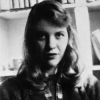
Sylvia Plath
Sylvia Plathwas one of the most renowned and influential poets, novelists, and short story writers of the 20th century. Born in Boston, Massachusetts, she studied at Smith College and Newnham College at the University of Cambridge before receiving acclaim as a poet and writer. She was married to fellow poet Ted Hughes from 1956 until they separated in September of 1962. They lived together in the United States and then the United Kingdom and had two children, Frieda and Nicholas...
NationalityAmerican
ProfessionPoet
Date of Birth27 October 1932
CountryUnited States of America
I love the people,' I said. 'I have room in me for love, and for ever so many little lives.
How can I tell Bob that my happiness streams from having wrenched a piece out of my life, a piece of hurt and beauty, and transformed it to typewritten words on paper? How can he know I am justifying my life, my keen emotions, my feeling, by turning it into print?
…'It always has to end, doesn't it? We always have to separate.' 'Yes,' I said. He was insistent, 'But it doesn't always have to be that way. We could be together some day for always.' 'Oh, no,' I told him, wondering if he knew it was all over. 'We keep running till we die. We separate, get further apart, till we are dead.
I had been alone more than I could have been had I gone by myself.
My flesh winced, in cowardice, from such a death.
What I fear most, I think, is the death of the imagination.
They would grow old. They would forget me.
Doreen had intuition. Everything she said was like a secret voice speaking straight out of my own bones.
I hate handing over money to people for doing what I could just as easily do myself, it makes me nervous.
Secretly, in studies and attics and schoolrooms all over America, people must be writing.
I wanted to tell her that if only something were wrong with my body it would be fine, I would rather have anything wrong with my body than something wrong with my head, but the idea seemed so involved and wearisome that I didn’t say anything. I only burrowed down further in the bed.
When I was nineteen, pureness was the great issue. Instead of the world being divided up into Catholics and Protestants or Republicans and Democrats or white men and black men or even men and women, I saw the world divided into people who had slept with somebody and people who hadn’t, and this seemed the only really significant difference between one person and another.
It was sometime in October; she had long ago lost track of all the days and it really didn’t matter because one was like another and there were no nights to separate them because she never slept any more.
I lay in that tub on the seventeenth floor of this hotel for-women-only, high up over the jazz and push of New York, for near unto an hour, and I felt myself growing pure again. I don't believe in baptism or the waters of Jordan or anything like that, but I guess I feel about a hot bath the way those religious people feel about holy water.