Thomas Carlyle
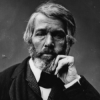
Thomas Carlyle
Thomas Carlylewas a Scottish philosopher, satirical writer, essayist, historian and teacher. Considered one of the most important social commentators of his time, he presented many lectures during his lifetime with certain acclaim in the Victorian era. One of those conferences resulted in his famous work On Heroes, Hero-Worship, and The Heroic in History where he explains that the key role in history lies in the actions of the "Great Man", claiming that "History is nothing but the biography of the...
NationalityScottish
ProfessionPhilosopher
Date of Birth4 December 1795
No sadder proof can be given by a man of his own littleness than disbelief in great men.
It is a strange trade that of advocacy. Your intellect, your highest heavenly gift is hung up in the shop window like a loaded pistol for sale.
Rightly viewed no meanest object is insignificant; all objects are as windows through which the philosophic eye looks into infinitude itself.
Be not a slave of words.
The real use of gunpowder is to make all men tall.
The actual well seen is ideal.
Evil, once manfully fronted, ceases to be evil; there is generous battle-hope in place of dead, passive misery; the evil itself has become a kind of good.
Generations are as the days of toilsome mankind; death and birth are the vesper and the matin bells that summon mankind to sleep and to rise refreshed for new advancement. What the father has made, the son can make and enjoy; but has also work of his own appointed him. Thus all things wax and roll onwards: arts, establishments, opinions, nothing is ever completed, but ever completing.
Shakespeare says, we are creatures that look before and after; the more surprising that we do not look around a little, and see what is passing under our very eyes.
There is no heroic poem in the world but is at bottom a biography, the life of a man.
Poetry is the attempt which man makes to render his existence harmonious.
Nature, after all, is still the grand agent in making poets.
It's a man's sincerity and depth of vision that makes him a poet.
Every poet, be his outward lot what it may, finds himself born in the midst of prose; h e has to struggle from the littleness and obstruction of an actual world into the freedom and infinitude of an ideal.