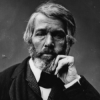
Thomas Carlyle
Thomas Carlyle
Thomas Carlylewas a Scottish philosopher, satirical writer, essayist, historian and teacher. Considered one of the most important social commentators of his time, he presented many lectures during his lifetime with certain acclaim in the Victorian era. One of those conferences resulted in his famous work On Heroes, Hero-Worship, and The Heroic in History where he explains that the key role in history lies in the actions of the "Great Man", claiming that "History is nothing but the biography of the...
NationalityScottish
ProfessionPhilosopher
Date of Birth4 December 1795
Piety does not mean that a man should make a sour face about things, and refuse to enjoy in moderation what his Maker has given.
Without oblivion, there is no remembrance possible. When both oblivion and memory are wise, when the general soul of man is clear, melodious, true, there may come a modern Iliad as memorial of the Past.
Man, it is not thy works, which are mortal, infinitely little, and the greatest no greater than the least, but only the spirit thou workest in, that can have worth or continuance.
Beautiful it is, and a gleam from the same eternal pole-star visible amid the destinies of men, that all talent, all intellect, is in the first plane moral. What a world were this otherwise!
Is not light grander than fire?
How, without clothes, could we possess the master organ, soul's seat and true pineal gland of the body social--I mean a purse?
Heroes have gone out; quacks have come in; the reign of quacks has not ended with the nineteenth century. The sceptre is held with a firmer grasp; the empire has a wider boundary. We are all the slaves of quackery in one shape or another. Indeed, one portion of our being is always playing the successful quack to the other.
Learn to be good readers, which is perhaps a more difficult thing than you imagine. Learn to be discriminative in your reading; to read faithfully, and with your best attention, all kinds of things which you have a real interest in,--a real, not an imaginary,--and which you find to be really fit for what you are engaged in.
Evil and good are everywhere, like shadow and substance; inseparable (for men) yet not hostile, only opposed.
With respect to duels, indeed, I have my own ideas. Few things in this so surprising world strike me with more surprise. Two little visual spectra of men, hovering with insecure enough cohesion in the midst of the unfathomable, and to dissolve therein, at any rate, very soon, make pause at the distance of twelve paces asunder; whirl around, and simultaneously by the cunningest mechanism, explode one another into dissolution; and, offhand, become air, and non-extant--the little spitfires!
There are remedies for all things but death.
I want to meet my God awake.
A man ought to inquire and find out what he really and truly has an appetite for; what suits his constitution; and that, doctors tell him, is the very thing he ought to have in general. And so with books.
Cease to brag to me of America, and its model institutions and constitutions. America, too, will have to strain its energies, crack its sinews, and all but break its heart, as the rest of us have had to do, in thousand-fold wrestle with the Pythons, and mud-demons, before it can become a babitation for the gods.