Thomas Jefferson
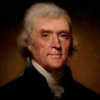
Thomas Jefferson
Thomas Jeffersonwas an American Founding Father who was the principal author of the Declaration of Independence. He was elected the second Vice President of the United States, serving under John Adams and in 1800 was elected the third President. Jefferson was a proponent of democracy, republicanism, and individual rights, which motivated American colonists to break from Great Britain and form a new nation. He produced formative documents and decisions at both the state and national level...
NationalityAmerican
ProfessionUS President
Date of Birth13 April 1743
CityShadwell, VA
CountryUnited States of America
The last hope of human liberty in this world rests on us.
Nothing is more certainly written in the book of fate than that these people are to be free. Nor is it less certain that the two races, equally free, cannot live in the same government. Nature, habit, opinion has drawn indelible lines of distinction between them.
I never before knew the full value of trees....What would I not give that the trees planted nearest round the house at Monticello were full grown.
The spirit of 1776 is not dead. It has only been slumbering. The body of the American people is substantially republican. But their virtuous feelings have been played on by some fact with more fiction; they have been the dupes of artful maneuvers, and made for a moment to be willing instruments in forging chains for themselves. But times and truth dissipated the delusion, and opened their eyes.
The error seems not sufficiently eradicated, that the operations of the mind, as well as the acts of the body, are subject to the coercion of the laws. But our rulers can have authority over such natural rights only as we have submitted to them. The rights of conscience we never submitted, we could not submit. We are answerable for them to our God. The legitimate powers of government extend to such acts only as are injurious to others.
A little rebellion now and then... is a medicine necessary for the sound health of government.
Common sense is the foundation of all authorities, of the laws themselves, and of their construction.
It is of great importance to set a resolution, not to be shaken, never to tell an untruth. There is no vice so mean, so pitiful, so contemptible; and he who permits himself to tell a lie once, finds it much easier to do it a second and a third time, till at length it becomes habitual.
Every man cannot have his way in all things. If his opinion prevails at some times, he should acquiesce on seeing that of others preponderate at other times. Without this mutual disposition we are disjointed individuals, but not a society.
The small landholders are the most precious part of a state.
What i value more than all things, good humor.
A well informed citizenry is the best defense against tyranny.
He who lights his [candle] at mine receives light without darkening me.
If a nation expects to be ignorant and free, it expects what never was and never will be ... The People cannot be safe without information. When the press is free, and every man is able to read, all is safe.