Thomas Jefferson
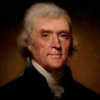
Thomas Jefferson
Thomas Jeffersonwas an American Founding Father who was the principal author of the Declaration of Independence. He was elected the second Vice President of the United States, serving under John Adams and in 1800 was elected the third President. Jefferson was a proponent of democracy, republicanism, and individual rights, which motivated American colonists to break from Great Britain and form a new nation. He produced formative documents and decisions at both the state and national level...
NationalityAmerican
ProfessionUS President
Date of Birth13 April 1743
CityShadwell, VA
CountryUnited States of America
My principles, and those always received by the republicans, do not admit to removing any person from office merely for a difference of political opinion. Malversations in office, and the exerting of official influence to control the freedom of election are good causes for removal.
Debt and revolution are inseparable as cause and effect.
We may say with truth and meaning, that governments are more or less republican, as they have more or less of the element of popular election and control in their composition; and believing as I do, that the mass of the citizens is the safest depository of their own rights and especially that the evils flowing from the duperies of the people are less injurious than those from the egoism of their agents, I am a friend to that composition of government which has in it the most of this ingredient.
It is a misnomer to call a government republican in which a branch of the supreme power is independent of the nation.
The spirit of 1776 is not dead. It had only been slumbering. The body of the American people is substantially republican.
The further the departure from direct and constant control by the citizens, the less has the government of the ingredient of republicanism...
I am persuaded myself that the good sense of the people will always be found to be the best army. They may be led astray for a moment, but will soon correct themselves. The people are the only censors of their governors; and even their errors will tend to keep these to the true principles of their institution.
The influence over government must be shared among all the people. If every individual which composes their mass participates of the ultimate authority, the government will be safe, because the corrupting of the whole mass will exceed any private resources of wealth, and public ones cannot be provided but by levies on the people. In this case every man would have to pay his own price.
The people are not always well-informed, but is better that they have misconceptions that make them restless than that they be lethargic-for lethargy in the people means death for republics.
Perfection in wisdom, as well as in integrity, is neither required nor expected in these agents (public servants). It belongs not to man. The wise know too well their weaknesses to assume infallibility; and he who knows most, knows best how little he knows.
If I could not go to heaven with but a party, I would not go there at all. Therefore, I am not of the party of federalists. But I am much further from that of the anti-federalists.
I love to see honest and honorable men at the helm, men who will not bend their politics to their purses, nor pursue measures by which they may profit, and then profit by their measures.
The best (remedy) I can devise would be to give future commissions to (federal) judges for six years with a re-appointability by the President with the approbation of both houses. If this would not be independence enough, I know not what would be...
The constitution has erected no such single tribunal, knowing that to whatever hands confided, with the corruption's of time and party, its members would become despots.