Thomas Jefferson
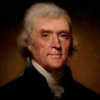
Thomas Jefferson
Thomas Jeffersonwas an American Founding Father who was the principal author of the Declaration of Independence. He was elected the second Vice President of the United States, serving under John Adams and in 1800 was elected the third President. Jefferson was a proponent of democracy, republicanism, and individual rights, which motivated American colonists to break from Great Britain and form a new nation. He produced formative documents and decisions at both the state and national level...
NationalityAmerican
ProfessionUS President
Date of Birth13 April 1743
CityShadwell, VA
CountryUnited States of America
And even should the cloud of barbarism and despotism again obscure the science and libraries of Europe, this country remains to preserve and restore light and liberty to them.
On a hot day in Virginia, I know nothing more comforting than a fine spiced pickle, brought up trout-like from the sparkling depths of the aromatic jar below the stairs of Aunt Sally's cellar.
Above all things, lose no occasion of exercising your dispositions to be grateful, to be generous, to be charitable, to be humane, to be true, just, firm, orderly, courageous, etc. Consider every act of this kind as an exercise which will strengthen your moral faculties and increase your worth.
It is every Americans' right and obligation to read and interpret the Constitution for himself.
Say nothing of my religion. It is known to God and myself alone.
Action will delineate and define you.
Our tenet ever was . . . that Congress had not unlimited powers to provide for the general welfare, but were restrained to those specifically enumerated; and that, as it was never meant that they should provide for that welfare but by the exercise of the enumerated powers, so it could not have been meant they should raise money for purposes which the enumeration did not place under their action.
I have often thought that if heaven had given me choice of my position and calling, it should have been on a rich spot of earth, well watered, and near a good market for the productions of the garden. No occupation is so delightful to me as the culture of the earth, and no culture comparable to that of the garden. Such a variety of subjects, some one always coming to perfection, the failure of one thing repaired by the success of another, and instead of one harvest a continued one through the year.
Those who don’t read the newspapers are better off than those who do insofar as those who know nothing are better off than those whose heads are filled with half-truths and lies.
We must use a good deal of economy in our wood, never cutting down new, where we can make the old do.
The system of banking have[for]ever reprobated. I contemplate it as a blot left in all our Constitutions, which, if not covered, will end in their destruction, which is already hit by the gamblers in corruption, and is sweeping away in its progress the fortunes and morals of our citizens.
That paper money has some advantages is admitted. But that its abuses also are inevitable and, by breaking up the measure of value, makes a lottery of all private property, cannot be denied.
The trifling economy of paper, as a cheaper medium, or its convenience for transmission, weighs nothing in opposition to the advantages of the precious metals it is liable to be abused, has been, is, and forever will be abused, in every country in which it is permitted.
Paper is poverty, it is only the ghost of money, and not money itself.