William James
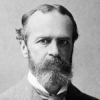
William James
William Jameswas an American philosopher and psychologist who was also trained as a physician. The first educator to offer a psychology course in the United States, James was one of the leading thinkers of the late nineteenth century and is believed by many to be one of the most influential philosophers the United States has ever produced, while others have labelled him the "Father of American psychology". Along with Charles Sanders Peirce and John Dewey, he is considered to be...
NationalityAmerican
ProfessionPhilosopher
Date of Birth11 January 1842
CityNew York City, NY
CountryUnited States of America
Many persons nowadays seem to think that any conclusion must be very scientific if the arguments in favor of it are derived from twitching of frogs' legs (especially if the frogs are decapitated) and that, on the other hand, any doctrine chiefly vouched for by the feelings of human beings (with heads on their shoulders) must be benighted and superstitious.
Life is one long struggle between conclusions based on abstract ways of conceiving cases, and opposite conclusions prompted by our instinctive perception of them.
Religion, whatever it is, is a man's total reaction upon life.
If you say that this is absurd, that we cannot be in love with everyone at once, I merely point out to you that, as a matter of fact, certain persons do exist with an enormous capacity for friendship and for taking delight in other people's lives; and that such person know more of truth than if their hearts were not so big. The vice of ordinary Jack and Jill affection is not its intensity, but its exclusions and its jealousies. Leave those out, and you see that the ideal I am holding up before you, however impracticable to-day, yet contains nothing intrinsically absurd.
Romeo wants Juliet as the filings want the magnet; and if no obstacles intervene he moves towards her by as straight a line as they. But Romeo and Juliet, if a wall be built between them, do not remain idiotically pressing their faces against its opposite sides like the magnet and the filings with the card. Romeo soon finds a circuitous way, by scaling the wall or otherwise, of touching Juliet's lips directly. With the filings the path is fixed; whether it reaches the end depends on accidents. With the lover it is the end which is fixed, the path may be modified indefinitely.
The first thing to learn in intercourse with others is non-interference with their own particular ways of being happy, provided those ways do not assume to interfere by violence with ours.
All the daily routine of life, our dressing and undressing, the coming and going from our work or carrying through of its various operations, is utterly without mental reference to pleasure and pain, except under rarely realized conditions.
Compared with what we ought to be, we are only half awake. Our fires are damped, our drafts are checked. We are making use of only a small part of our possible mental and physical resources.
The one who thinks over his experiences most, and weaves them into systematic relations with each other, will be the one with the best memory.
How can the moribund old man reason back to himself the romance, the mystery, the imminence of great things with which our old earth tingled for him in the days when he was young and well?
To improve the golden moment of opportunity, and catch the good that is within our reach, is the great art of life.
If you wish to upset the law that all crows are black, you mustn't seek to show that no crows are; it is enough if you prove one single crow to be white.
The lunatic's visions of horror are all drawn from the material of daily fact. Our civilization is founded on the shambles, and every individual existence goes out in a lonely spasm of helpless agony.
There are two lives, the natural and the spiritual, and we must lose the one before we can participate in the other.