William James
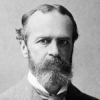
William James
William Jameswas an American philosopher and psychologist who was also trained as a physician. The first educator to offer a psychology course in the United States, James was one of the leading thinkers of the late nineteenth century and is believed by many to be one of the most influential philosophers the United States has ever produced, while others have labelled him the "Father of American psychology". Along with Charles Sanders Peirce and John Dewey, he is considered to be...
NationalityAmerican
ProfessionPhilosopher
Date of Birth11 January 1842
CityNew York City, NY
CountryUnited States of America
Whatever universe a professor believes in must at any rate be a universe that lends itself to lengthy discourse. A universe definable in two sentences is something for which the professorial intellect has no use. No faith in anything of that cheap kind!
Between what a man calls me and what he simply calls mine the line is difficult to draw. We feel and act about certain things that are ours very much as we feel and act about ourselves.
We are thinking beings, and we cannot exclude the intellect from participating in any of our functions.
Divinity lies all around us, but society remains too hidebound to accept that fact...The mother sea and the fountain-head of all religions lies in the mystical experiences of the individual.
In its broadest term, religion says that there is an unseen order, and that our supreme good lies in rightful relations to it.
The bottom of being is left logically opaque to us, a datum in the strict sense of the word, something we simply come upon and find, and about which (if we wish to act) we should pause and wonder as little as possible. In this confession lies the lasting truth of empiricism.
The intellectual life of man consists almost wholly in his substitution of conceptual order for the perceptual order in which his experience originally comes.
Modern man . . . has not ceased to be credulous . . . the need to believe haunts him.
No decision is, in itself, a decision.
I do indeed disbelieve that we or any other mortal men can attain on a given day to absolutely incorrigible and unimprovable truth about such matters of fact as those with which religions deal. But I reject this dogmatic ideal not out of a perverse delight in intellectual instability. I am no lover of disorder and doubt as such. Rather do I fear to lose truth by this pretension to possess it already wholly.
As there is no worse lie than a truth misunderstood by those who hear it, so reasonable arguments, challenges to magnanimity, and appeals to sympathy or justice, are folly when we are dealing with human crocodiles and boa-constrictors.
Our normal waking consciousness, rational consciousness as we call it, is but one special type of consciousness, whilst all about it, parted from it by the filmiest of screens, there lie potential forms of consciousness entirely different.
We are spinning our own fates, good or evil, and never to be undone. Every smallest stroke of virtue or of vice leaves its ever so little scar...Nothing we ever do is, in strict scientific literalness, wiped out.
Science can tell us what exists; but to compare the worths, both of what exists and of what does not exist, we must consult not science, but what Pascal calls our heart.