William James
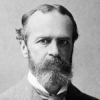
William James
William Jameswas an American philosopher and psychologist who was also trained as a physician. The first educator to offer a psychology course in the United States, James was one of the leading thinkers of the late nineteenth century and is believed by many to be one of the most influential philosophers the United States has ever produced, while others have labelled him the "Father of American psychology". Along with Charles Sanders Peirce and John Dewey, he is considered to be...
NationalityAmerican
ProfessionPhilosopher
Date of Birth11 January 1842
CityNew York City, NY
CountryUnited States of America
Footnotes -- little dogs yapping at the heels of the text
The most violent revolutions in an individuals beliefs leave most of his old order standing. Time and space, cause and effect, nature and history, and ones own biography remain untouched. New truth is always a go-between, a smoother-over of transitions. It marries old opinion to new fact so as ever to show a minimum of jolt, a maximum of continuity.
To spend life for something which outlasts it.
. . . [we] read in the bystander's eyes the success or failure of our own conduct.
Humanism . . . is not a single hypothesis or theorem, and it dwells on no new facts. It is rather a slow shifting in the philosophic perspective, making things appear as from a new centre of interest or point of sight.
Despair lames most people, but it wakes others fully up.
It is only in the lonely emergencies of life that our creed is tested: then routine maxims fail, and we fall back on our gods.
A Beethoven string-quartet is truly, as some one has said, a scraping of horses' tails on cats' bowels, and may be exhaustively described in such terms; but the application of this description in no way precludes the simultaneous applicability of an entirely different description.
Religious awe is the same organic thrill which we feel in a forest at twilight, or in a mountain gorge.
So with the man who has daily inured himself to habits of concentrated attention, energetic volition, and self-denial in unnecessary things. He will stand like a tower when everything rocks around him, and when his softer fellow-mortals are winnowed like chaff in the blast.
Let anyone try, I will not say to arrest, but to notice or to attend to, the present moment of time. One of the most baffling experiences occurs. Where is it, this present? It has melted in our grasp, fled ere we could touch it, gone in the instant of becoming.
History is a bath of blood.
The first thing the intellect does with an object is to class it along with something else. But any object that is infinitely important to us and awakens our devotion feels to us also as if it must be sui generis and unique. Probably a crab would be filled with a sense of personal outrage if it could hear us class it without ado or apology as a crustacean, and thus dispose of it. 'I am no such thing,' it would say; 'I am MYSELF, MYSELF alone.
Impulse without reason is not enough, and reason without impulse is a poor makeshift.