Aleksandr Solzhenitsyn
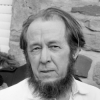
Aleksandr Solzhenitsyn
Aleksandr Isayevich Solzhenitsyn was a Russian novelist, historian, and short story writer. He was an outspoken critic of the Soviet Union and its totalitarianism and helped to raise global awareness of its Gulag forced labor camp system. He was allowed to publish only one work in the Soviet Union, One Day in the Life of Ivan Denisovich, in the periodical Novy Mir. After this he had to publish in the West, most notably Cancer Ward, August 1914, and The Gulag...
NationalityRussian
ProfessionNovelist
Date of Birth11 December 1918
CityKislovodsk, Russia
CountryRussian Federation
Aleksandr Solzhenitsyn quotes about
If you ever get twenty-five years for nothing, if you find yourself wearing four number patches on your clothes, holding your hands permanently behind your back, submitting to searches morning and evening, working until you are utterly exhausted, dragged into the cooler whenever someone denounces you, trodden deeper and deeper into the ground-from the hole you're in, the fine words of the great humanists will sound like the chatter of the well-fed and free.
[He] understood the people in a new way...The people is not everyone who speaks our language, nor yet the elect marked by the fiery stamp of genius. Not by birth, not by the work of one's hands, not by the wings of education is one elected into the people. But by one's inner self. Everyone forges his inner self year after year. One must try to temper, to cut, to polish one's soul so as to become a human being. And thereby become a tiny particle of one's own people.
It makes me happier, more secure, to think that I do not have to plan and manage everything for myself, that I am only a sword made sharp to smite the unclean forces, an enchanted sword to cleave and disperse them. Grant, O Lord, that I may not break as I strike! Let me not fall from Thy hand!
To his and everybody else's way of thinking, you should build a house with your own hands before you start talking about being an engineer.
You must understand, the leading Bolsheviks who took over Russia were not Russians. They hated Russians. They hated Christians. Driven by ethnic hatred they tortured and slaughtered millions of Russians without a shred of human remorse. It cannot be overstated. Bolshevism committed the greatest human slaughter of all time. The fact that most of the world is ignorant and uncaring about this enormous crime is proof that the global media is in the hands of the perpetrators.
You can have power over people as long as you don't take everything away from them. But when you've robbed a man of everything, he's no longer in you power.
When I was young, the early death of my father cast a shadow over me - and I was afraid to die before all my literary plans came true. But between 30 and 40 years of age my attitude to death became quite calm and balanced. I feel it is a natural, but no means the final, milestone of one's existence.
Communist propaganda would sometimes include statements such as "we include almost all the commandments of the Gospel in our ideology". The difference is that the Gospel asks all this to be achieved through love, through self-limitation, but socialism only uses coercion. This is one point.
For me faith is the foundation and support of one's life.
Religion itself cannot but be dynamic. In order to combat modern materialistic mores, to fight nihilism and egotism, religion must also develop, must be flexible in its forms, and it must have a correlation with the cultural forms of the epoch.
We should clearly understand that only the voluntary and conscientious acceptance by a people of its guilt can ensure the healing of a nation. Unremitting reproaches from outside are counterproductive.
Voting for impersonal parties and their programmes is a false substitute for the only true way to elect people's representatives: voting by an actual person for an actual candidate.
I am deeply convinced that God is present both in the lives of every person and also in the lives of entire nations.
Periods of rapid and fundamental change were never favourable for literature. Significant works, have nearly always and everywhere been created in periods of stability, be it good or bad.