Aleksandr Solzhenitsyn
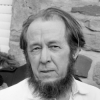
Aleksandr Solzhenitsyn
Aleksandr Isayevich Solzhenitsyn was a Russian novelist, historian, and short story writer. He was an outspoken critic of the Soviet Union and its totalitarianism and helped to raise global awareness of its Gulag forced labor camp system. He was allowed to publish only one work in the Soviet Union, One Day in the Life of Ivan Denisovich, in the periodical Novy Mir. After this he had to publish in the West, most notably Cancer Ward, August 1914, and The Gulag...
NationalityRussian
ProfessionNovelist
Date of Birth11 December 1918
CityKislovodsk, Russia
CountryRussian Federation
Aleksandr Solzhenitsyn quotes about
You can have power over people as long as you don't take everything away from them. But when you've robbed a man of everything, he's no longer in you power.
We should clearly understand that only the voluntary and conscientious acceptance by a people of its guilt can ensure the healing of a nation. Unremitting reproaches from outside are counterproductive.
Voting for impersonal parties and their programmes is a false substitute for the only true way to elect people's representatives: voting by an actual person for an actual candidate.
For us in Russia, communism is a dead dog, while, for many people in the West, it is still a living lion.
If I were asked today to formulate as concisely as possible what was the main cause of the ruinous revolution that swallowed up some 60 million of our people, I could not put it more accurately than to repeat: 'Men had forgotten God; that is why all this has happened.'
Some are bound to die young. By dying young a person stays young in people's memory. If he burns brightly before he dies, his brightness shines for all time.
But there are still people whose moral superiority defeats your own.
What would things been like [in Russia] if during periods of mass arrests people had not simply sat there, paling with terror at every bang on the downstairs door and at every step on the staircase, but understood they had nothing to lose and had boldly set up in the downstairs hall an ambush of half a dozen people?
The less you speak, the more you will hear.
We have to condemn the very idea that some people have the right to repress others.
Literature that is not the breath of contemporary society, that dares not transmit the pains and fears of that society . . . loses the confidence of its own people, and its published works are used as wastepaper instead of being read.
People can live through hardship, but from hard feelings they perish.
Justness exists, even if few people exist who feel it.
To destroy a people, you must first sever their roots.