Aleksandr Solzhenitsyn
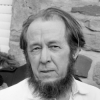
Aleksandr Solzhenitsyn
Aleksandr Isayevich Solzhenitsyn was a Russian novelist, historian, and short story writer. He was an outspoken critic of the Soviet Union and its totalitarianism and helped to raise global awareness of its Gulag forced labor camp system. He was allowed to publish only one work in the Soviet Union, One Day in the Life of Ivan Denisovich, in the periodical Novy Mir. After this he had to publish in the West, most notably Cancer Ward, August 1914, and The Gulag...
NationalityRussian
ProfessionNovelist
Date of Birth11 December 1918
CityKislovodsk, Russia
CountryRussian Federation
Aleksandr Solzhenitsyn quotes about
I refuse to see literature as amusement, as a game. I think that you ought not to approach literature without a moral responsibility for every word you write.
In our age, when technology is gaining control over life, when material well-being is considered the most important goal, when the influence of religion has been weakened everywhere in the world, a special responsibility lies upon the writer.
... it is a major responsibility ... of all communication for each of us to help everyone else discover the best that is in him.
The salvation of mankind lies only in making everything the concern of all.
European democracy was originally imbued with a sense of Christian responsibility and self-discipline, but these spiritual principles have been gradually losing their force. Spiritual independence is being pressured on all sides by the dictatorship of self-satisfied vulgarity, of the latest fads, and of group interests.
We hear a constant clamor for rights, rights, always rights, but so very little about responsibility. And we have forgotten God. The need now is for selflessness, for a spirit of sacrifice, for a willingness to put aside personal gains for the salvation of the whole Western world.
You can have power over people as long as you don't take everything away from them. But when you've robbed a man of everything, he's no longer in you power.
When I was young, the early death of my father cast a shadow over me - and I was afraid to die before all my literary plans came true. But between 30 and 40 years of age my attitude to death became quite calm and balanced. I feel it is a natural, but no means the final, milestone of one's existence.
Communist propaganda would sometimes include statements such as "we include almost all the commandments of the Gospel in our ideology". The difference is that the Gospel asks all this to be achieved through love, through self-limitation, but socialism only uses coercion. This is one point.
For me faith is the foundation and support of one's life.
Religion itself cannot but be dynamic. In order to combat modern materialistic mores, to fight nihilism and egotism, religion must also develop, must be flexible in its forms, and it must have a correlation with the cultural forms of the epoch.
We should clearly understand that only the voluntary and conscientious acceptance by a people of its guilt can ensure the healing of a nation. Unremitting reproaches from outside are counterproductive.
Voting for impersonal parties and their programmes is a false substitute for the only true way to elect people's representatives: voting by an actual person for an actual candidate.
I am deeply convinced that God is present both in the lives of every person and also in the lives of entire nations.