Aristotle
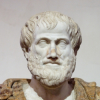
Aristotle
Aristotle was a Greek philosopher and scientist born in the city of Stagira, Chalkidice, on the northern periphery of Classical Greece. His father, Nicomachus, died when Aristotle was a child, whereafter Proxenus of Atarneus became his guardian. At eighteen, he joined Plato's Academy in Athens and remained there until the age of thirty-seven. His writings cover many subjects – including physics, biology, zoology, metaphysics, logic, ethics, aesthetics, poetry, theater, music, rhetoric, linguistics, politics and government – and constitute the first comprehensive system...
NationalityGreek
ProfessionPhilosopher
Time is the measurable unit of movement concerning a before and an after.
Friendship is a thing most necessary to life, since without friends no one would choose to live, though possessed of all other advantages.
Memory is therefore, neither Perception nor Conception, but a state or affection of one of these, conditioned by lapse of time. As already observed, there is no such thing as memory of the present while present, for the present is object only of perception, and the future, of expectation, but the object of memory is the past. All memory, therefore, implies a time elapsed; consequently only those animals which perceive time remember, and the organ whereby they perceive time is also that whereby they remember.
If men are given food, but no chastisement nor any work, they become insolent.
Our youth should also be educated with music and physical education.
Anything that we have to learn to do we learn by the actual doing of it; People become builders by building and instrumentalists by playing instruments. Similarily, we become just by performing just acts, temperate by performing temperate ones, brave by performing brave ones.
Everybody loves a thing more if it has cost him trouble: for instance those who have made money love money more than those who have inherited it.
Now that practical skills have developed enough to provide adequately for material needs, one of these sciences which are not devoted to utilitarian ends [mathematics] has been able to arise in Egypt, the priestly caste there having the leisure necessary for disinterested research.
In revolutions the occasions may be trifling but great interest are at stake.
Where perception is, there also are pain and pleasure, and where these are, there, of necessity, is desire.
Just as at the Olympic games it is not the handsomest or strongest men who are crowned with victory but the successful competitors, so in life it is those who act rightly who carry off all the prizes and rewards.
If the consequences are the same it is always better to assume the more limited antecedent, since in things of nature the limited, as being better, is sure to be found, wherever possible, rather than the unlimited.
Such an event is probable in Agathon's sense of the word: 'it is probable,' he says, 'that many things should happen contrary to probability.'
Experience has shown that it is difficult, if not impossible, for a populous state to be run by good laws.