Aristotle
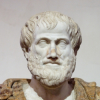
Aristotle
Aristotle was a Greek philosopher and scientist born in the city of Stagira, Chalkidice, on the northern periphery of Classical Greece. His father, Nicomachus, died when Aristotle was a child, whereafter Proxenus of Atarneus became his guardian. At eighteen, he joined Plato's Academy in Athens and remained there until the age of thirty-seven. His writings cover many subjects – including physics, biology, zoology, metaphysics, logic, ethics, aesthetics, poetry, theater, music, rhetoric, linguistics, politics and government – and constitute the first comprehensive system...
NationalityGreek
ProfessionPhilosopher
Whereas young people become accomplished in geometry and mathematics, and wise within these limits, prudent young people do not seem to be found. The reason is that prudence is concerned with particulars as well as universals, and particulars become known from experience, but a young person lacks experience, since some length of time is needed to produce it.
The final cause, then, produces motion through being loved.
To say of what is that it is not, or of what is not that it is, is false, while to say of what is that it is, and of what is not that it is not, is true.
The life of theoretical philosophy is the best and happiest a man can lead. Few men are capable of it and then only intermittently. For the rest there is a second-best way of life, that of moral virtue and practical wisdom.
Metaphysics involves intuitive knowledge of unprovable starting-points concepts and truth and demonstrative knowledge of what follows from them.
But also philosophy is not about perceptible substances they, you see, are prone to destruction.
... the science we are after is not about mathematicals either none of them, you see, is separable.
... a science must deal with a subject and its properties.
Demonstration is also something necessary, because a demonstration cannot go otherwise than it does, ... And the cause of this lies with the primary premises/principles.
... There must then be a principle of such a kind that its substance is activity.
...The entire preoccupation of the physicist is with things that contain within themselves a principle of movement and rest.
It is clear, then, that wisdom is knowledge having to do with certain principles and causes. But now, since it is this knowledge that we are seeking, we must consider the following point: of what kind of principles and of what kind of causes is wisdom the knowledge?
Aristotle suggests that the rotating Earth was a generally accepted tenet of Pythagorism: "While most of those who hold that the whole heaven is finite say that the earth lies at the center, the philosophers of Italy, the so-called Pythagoreans, assert the contrary. They say that in the middle there is fire, and that the earth is one of the stars, and by its circular motion round the center produces night and day."
You'll understand what life is if you think about the act of dying. When I die, how will I be different from the way I am right now? In the first moments after death, my body will be scarcely different in physical terms than it was in the last seconds of life, but I will no longer move, no longer sense, nor speak, nor feel, nor care. It's these things that are life. At that moment, the psyche takes flight in the last breath.