Aristotle
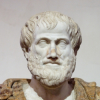
Aristotle
Aristotle was a Greek philosopher and scientist born in the city of Stagira, Chalkidice, on the northern periphery of Classical Greece. His father, Nicomachus, died when Aristotle was a child, whereafter Proxenus of Atarneus became his guardian. At eighteen, he joined Plato's Academy in Athens and remained there until the age of thirty-seven. His writings cover many subjects – including physics, biology, zoology, metaphysics, logic, ethics, aesthetics, poetry, theater, music, rhetoric, linguistics, politics and government – and constitute the first comprehensive system...
NationalityGreek
ProfessionPhilosopher
Virtue is more clearly shown in the performance of fine ACTIONS than in the non-performance of base ones.
If you prove the cause, you at once prove the effect; and conversely nothing can exist without its cause.
The Eyes are the organs of temptation, and the Ears are the organs of instruction.
Metaphysics is universal and is exclusively concerned with primary substance. ... And here we will have the science to study that which is, both in its essence and in the properties which it has.
For this reason poetry is something more philosophical and more worthy of serious attention than history.
A democracy exists whenever those who are free and are not well-off, being in the majority, are in sovereign control of government, an oligarchy when control lies with the rich and better-born, these being few.
The right constitutions, three in number- kingship, aristocracy, and polity- and the deviations from these, likewise three in number - tyranny from kingship, oligarchy from aristocracy, democracy from polity.
.. for desire is like a wild beast, and anger perverts rulers and the very best of men. Hence law is intelligence without appetition.
. .we would have to say that hereditary succession is harmful. You may say the king, having sovereign power, will not in that case hand over to his children. But it is hard to believe that: it is a difficult achievement, which expects too much virtue of human nature.
Perhaps here we have a clue to the reason why royal rule used to exist formerly, namely the difficulty of finding enough men of outstanding virtue ..
To let them share in the highest offices is to take a risk; inevitably, their unjust standards will cause them to commit injustice, and their lack of judgement will lead them into error. On the other hand there is a risk in not giving them a share, and in their non participation, for when there are many who have no property and no honours they inevitably constitute a huge hostile element in the state. But it can still remain open to them to participate in deliberating and judging.
But it is not at all certain that this superiority of the many over the sound few is possible in the case of every people and every large number. There are some whom it would be impossible: otherwise the theory would apply to wild animals- and yet some men are hardly any better than wild animals.
A man who examines each subject from a philosophical standpoint cannot neglect them: he has to omit nothing, and state the truth about each topic.
It is clear that those constitutions which aim at the common good are right, as being in accord with absolute justice; while those which aim only at the good of the rulers are wrong.