Aristotle
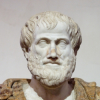
Aristotle
Aristotle was a Greek philosopher and scientist born in the city of Stagira, Chalkidice, on the northern periphery of Classical Greece. His father, Nicomachus, died when Aristotle was a child, whereafter Proxenus of Atarneus became his guardian. At eighteen, he joined Plato's Academy in Athens and remained there until the age of thirty-seven. His writings cover many subjects – including physics, biology, zoology, metaphysics, logic, ethics, aesthetics, poetry, theater, music, rhetoric, linguistics, politics and government – and constitute the first comprehensive system...
NationalityGreek
ProfessionPhilosopher
While those whom devotion to abstract discussions has rendered unobservant of the facts are too ready to dogmatize on the basis of a few observations.
A man is the origin of his action.
Most persons think that a state in order to be happy ought to be large; but even if they are right, they have no idea of what is a large and what a small state.... To the size of states there is a limit, as there is to other things, plants, animals, implements; for none of these retain their natural power when they are too large or too small, but they either wholly lose their nature, or are spoiled.
The line has magnitude in one way, the plane in two ways, and the solid in three ways, and beyond these there is no other magnitude because the three are all.
Our account does not rob the mathematicians of their science... In point of fact they do not need the infinite and do not use it.
Should a man live underground, and there converse with the works of art and mechanism, and should afterwards be brought up into the open day, and see the several glories of the heaven and earth, he would immediately pronounce them the work of such a Being as we define God to be.
And this activity alone would seem to be loved for its own sake; for nothing arises from it apart from the contemplating, while from practical activities we gain more or less apart from the action. And happiness is thought to depend on leisure; for we are busy that we may have leisure, and make war that we may live in peace.
A line is not made up of points. ... In the same way, time is not made up parts considered as indivisible 'nows.' Part of Aristotle's reply to Zeno's paradox concerning continuity.
We, on the other hand, must take for granted that the things that exist by nature are, either all or some of them, in motion.
For any two portions of fire, small or great, will exhibit the same ratio of solid to void; but the upward movement of the greater is quicker than that of the less, just as the downward movement of a mass of gold or lead, or of any other body endowed with weight, is quicker in proportion to its size.
Here and elsewhere we shall not obtain the best insight into things until we actually see them growing from the beginning.
He who thus considers things in their first growth and origin ... will obtain the clearest view of them.
We must not feel a childish disgust at the investigations of the meaner animals. For there is something marvelous in all natural things.
As for the story, whether the poet takes it ready made or constructs it for himself, he should first sketch its general outline, and then fill in the episodes and amplify in detail.