Friedrich Nietzsche
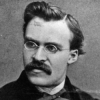
Friedrich Nietzsche
Friedrich Wilhelm Nietzschewas a German philosopher, cultural critic, poet and Latin and Greek scholar whose work has exerted a profound influence on Western philosophy and modern intellectual history. He began his career as a classical philologist before turning to philosophy. He became the youngest ever to hold the Chair of Classical Philology at the University of Basel in 1869, at the age of 24. Nietzsche resigned in 1879 due to health problems that plagued him most of his life, and...
NationalityGerman
ProfessionPhilosopher
Date of Birth15 October 1844
CityRocken, Germany
CountryGermany
What can everyone do? Praise and blame. This is human virtue, this is human madness.
I absolutely cannot see how one can later make up for having failed to go to a good school at the proper time. For this is what distinguishes the hard school as a good school from all others: that much is demanded; and sternly demanded; that the good, even the exceptional, is demanded as the norm; that praise is rare, that indulgence is nonexistent; that blame is apportioned sharply, objectively, without regard for talent or antecedents. What does one learn in a hard school? Obeying and commanding.
What is life? A continuous praise and blame.
Undeserved praise causes more pangs of conscience later than undeserved blame, but probably only for this reason, that our power of judgment are more completely exposed by being over praised than by being unjustly underestimated.
In praise there is more obtrusiveness than in blame.
A politician divides mankind into two classes: tools and enemies.
God is a gross answer, an indelicacy against us thinkers- at bottom merely a gross prohibition for us: you shall not think!
Not when truth is dirty, but when it is shallow, does the enlightened man dislike to wade into its waters.
I am a pure-blooded Polish nobleman without a single drop of bad blood - certainly not German blood.
In individuals, insanity is rare; but in groups, parties, nations and epochs, it is the rule.
Madness is rare in individuals - but in groups, parties, nations, and ages it is the rule.
Germany is a great nation only because its people have so much Polish blood in their veins.
We should consider every day lost on which we have not danced at least once. And we should call every truth false which was not accompanied by at least one laugh.
However modest one may be in one's demand for intellectual cleanliness, one cannot help feeling, when coming into contact with the New Testament, a kind of inexpressible discomfiture: for the unchecked impudence with which the least qualified want to raise their voice on the greatest problems, and even claim to be judges of things, surpasses all measure. The shameless levity with which the most intractable problems (life, world, God, purpose of life) are spoken of, as if they were not problems at all but simply things that these little bigots KNEW!