Friedrich Nietzsche
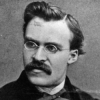
Friedrich Nietzsche
Friedrich Wilhelm Nietzschewas a German philosopher, cultural critic, poet and Latin and Greek scholar whose work has exerted a profound influence on Western philosophy and modern intellectual history. He began his career as a classical philologist before turning to philosophy. He became the youngest ever to hold the Chair of Classical Philology at the University of Basel in 1869, at the age of 24. Nietzsche resigned in 1879 due to health problems that plagued him most of his life, and...
NationalityGerman
ProfessionPhilosopher
Date of Birth15 October 1844
CityRocken, Germany
CountryGermany
My humanity is a constant self-overcoming.
As a human being Plato mingles regal, exclusive, and self-contained features with melancholy compassion.
Subordination to morality can be slavish or vain or self- interested or resigned or gloomily enthusiastic or thoughtless or an act of despair, just as subordination to a prince can be: in itself it is nothing moral.
Lust and self-mutilation are closely related impulses. There are also self-mutilators among knowers: they do not want to be creators under any circumstances.
The golden fleece of self-sufficiency guards against cudgel- blows but not against pin-pricks.
Active, successful natures act, not according to the maxim, "know thyself," but as if prompted by the commandment: will a self, and so become a self.
To those human beings who are of any concern to me, I wish suffering, desolation, sickness, ill treatment, indignities, profound self-contempt, the torture of self-mistrust, and the wretchedness of the vanquished.
When one gives up Christian belief one thereby deprives oneself of the right to Christian morality. For the latter is absolutely not self-evident: one must make this point clear again and again, in spite of English shallowpates.
The surest aid in combating the male's disease of self-contempt is to be loved by a clever woman.
And this do I call immaculate perception of all things: to want nothing else from them, but to be allowed to lie before them as a mirror with a hundred facets.
Many a one cannot loosen his own fetters, but is nevertheless his friend's emancipator.
There is a universal need to exercise some kind of power, or to create for one's self the appearance of some power, if only temporarily, in the form of intoxication.
How much rationality and higher protection there is in such self-deception, and how much falseness I still require in order to allow myself again and again the luxury of my sincerity.
That, however, is - mediocrity, though it be called moderation.