Friedrich Nietzsche
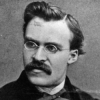
Friedrich Nietzsche
Friedrich Wilhelm Nietzschewas a German philosopher, cultural critic, poet and Latin and Greek scholar whose work has exerted a profound influence on Western philosophy and modern intellectual history. He began his career as a classical philologist before turning to philosophy. He became the youngest ever to hold the Chair of Classical Philology at the University of Basel in 1869, at the age of 24. Nietzsche resigned in 1879 due to health problems that plagued him most of his life, and...
NationalityGerman
ProfessionPhilosopher
Date of Birth15 October 1844
CityRocken, Germany
CountryGermany
God is a gross answer, an indelicacy against us thinkers- at bottom merely a gross prohibition for us: you shall not think!
The happiness of man is: I will. The happiness of woman is: he wills. ‘Behold, just now the world became perfect!’—thus thinks every woman when she obeys out of entire love. And women must obey and find a depth for her surface. Surface is the disposition of woman: a mobile, stormy film over shallow water. Man’s disposition, however, is deep; his river roars in subterranean caves: woman feels his strength but does not comprehend it.
We think that play and fairytales belong to childhood - how shortsighted that is! As though we would want at any time in our life to live without play and fairytales! We give these things other names, to be sure, and feel differently about them, but precisely this is the evidence that they are the same things, for the child too regards play as his work and fairy tales as his truth. The brevity of life ought to preserve us from a pedantic division of life into different stages - as though each brought something new...
The saying, "The Magyar is much too lazy to be bored," is worth thinking about. Only the most subtle and active animals are capable of boredom.--A theme for a great poet would be God's boredom on the seventh day of creation.
Lying very still and thinking very little is the most inexpensive medicine for all the sicknesses of the soul, and when administered with good intentions it grows more and more pleasant with each passing hour.
Asceticism is the right way of thinking for those who have to extirpate their sensual drives because they are ravening beasts of prey. But only for those!
When one thinks profusely and cleverly, not only his face but his body too takes on a clever appearance.
A matter that becomes clear ceases to concern us.--What was that god thinking who counseled, "Know thyself!" Did he perhaps mean,"Cease to concern yourself! Become objective!"--And Socrates?--And "scientific men"?
Everyone nowadays lives through too much and thinks through too little: they have a ravenous appetite and colic at the same time so that they keep getting thinner and thinner no matter how much they eat.--Whoever says nowadays, "I have not experienced anything"--is a simpleton.
The thought is merely a sign, as the word is merely a sign for the thought.
We cannot even reproduce our thoughts entirely in words.
Those with very loud voices in their throats are nearly incapable of thinking subtle thoughts.
To one who is accustomed to thinking a lot, every new thought that he hears or reads about immediately appears as a link in a chain.
What verse is for the poet, dialectical thinking is for the philosopher. He grasps for it in order to get hold of his own enchantment, in order to perpetuate it.