Friedrich Nietzsche
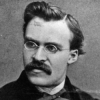
Friedrich Nietzsche
Friedrich Wilhelm Nietzschewas a German philosopher, cultural critic, poet and Latin and Greek scholar whose work has exerted a profound influence on Western philosophy and modern intellectual history. He began his career as a classical philologist before turning to philosophy. He became the youngest ever to hold the Chair of Classical Philology at the University of Basel in 1869, at the age of 24. Nietzsche resigned in 1879 due to health problems that plagued him most of his life, and...
NationalityGerman
ProfessionPhilosopher
Date of Birth15 October 1844
CityRocken, Germany
CountryGermany
Not when truth is dirty, but when it is shallow, does the enlightened man dislike to wade into its waters.
The wisest man would be the one richest in contradictions, who has, as it were, antennae for all types of men---as well as his great moments of grand harmony---a rare accident even in us! A sort of planetary motion---
There is no pre-established harmony between the furtherance of truth and the well-being of mankind.
The noble man honours in himself the powerful one, him also who has power over himself, who knows how to speak and how to keep silence, who takes pleasure in subjecting himself to severity and hardness, and has reverence for all that is severe and hard.
There is no more dreary or more repulsive creature than the man who has evaded his genius.
It's not the intensity of the man, but the duration of his intensity that makes the man great.
Whoever possesses abundant joy must be a good man: but he is probably not the cleverest man, although he achieves exactly what it is that the cleverest man strives with all his cleverness to achieve.
Pharisaism is not a degeneration in a good man: a large portion of it is rather the condition of all being-good.
How much reverence has a noble man for his enemies!--and such reverence is a bridge to love.--For he desires his enemy for himself, as his mark of distinction; he can endure no other enemy than one in whom there is nothing to despise and very much to honor! In contrast to this, picture "the enemy" as the man of ressentiment conceives him--and here precisely is his deed, his creation: he has conceived "the evil enemy," "the Evil One," and this in fact is his basic concept, from which he then evolves, as an afterthought and pendant, a "good one"--himself!
Liberalism is the transformation of mankind into cattle.
Strength is the morality of the man who stands out from the rest, and it is mine.
Regarding life, the wisest men of all ages have judged alike: it is worthless.
Fanatics are picturesque, mankind would rather see gestures than listen to reasons.
All mankind is divided, as it was at all times and is still, into slaves and freemen.