Friedrich Nietzsche
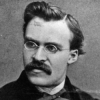
Friedrich Nietzsche
Friedrich Wilhelm Nietzschewas a German philosopher, cultural critic, poet and Latin and Greek scholar whose work has exerted a profound influence on Western philosophy and modern intellectual history. He began his career as a classical philologist before turning to philosophy. He became the youngest ever to hold the Chair of Classical Philology at the University of Basel in 1869, at the age of 24. Nietzsche resigned in 1879 due to health problems that plagued him most of his life, and...
NationalityGerman
ProfessionPhilosopher
Date of Birth15 October 1844
CityRocken, Germany
CountryGermany
Truth as Circe. - Error has transformed animals into men; is truth perhaps capable of changing man back into an animal?
What then in the last resort are the truths of mankind? They are the irrefutable errors of mankind.
How little is required for pleasure! The sound of a bagpipe - without music, life would be an error.
Life without music is only error, exhaustion, exile... Indeed, there is nothing that concerns me more than the fate of music.
Zarathustra was the first to consider the fight of good and evil the very wheel in the machinery of things: the transposition of morality into the metaphysical realm, as a force, cause, and end in itself, is his work. [...] Zarathustra created this most calamitous error, morality; consequently, he must also be the first to recognize it.
It is not to everyone's taste that truth should be pronounced pleasant. But at least let no one believe that error becomes truth when it is pronounced unpleasant.
Truth is the kind of error without which a certain species of life could not live. The value for life is ultimately decisive.
Antithesis is the narrow gateway through which error most prefers to worm its way towards truth.
Great men's errors are to be venerated as more fruitful than little men's truths.
But in the end one also has to understand that the needs that religion has satisfied and philosophy is now supposed to satisfy are not immutable; they can be weakened and exterminated. Consider, for example, that Christian distress of mind that comes from sighing over ones inner depravity and care for ones salvation - all concepts originating in nothing but errors of reason and deserving, not satisfaction, but obliteration.
The newspaper reader says: this party will ruin itself if it makes errors like this. My higher politics says: a party which makes errors like this is already finished -- it is no longer secure in its instincts.
We have arranged for ourselves a world in which we can live - by positing bodies, lines, planes, causes and effects, motion and rest, form and content; without these articles of faith nobody could now endure life. But that does not prove them. Life is no argument. The conditions of life might include error.
What are man's truths ultimately? Merely his irrefutable errors.
What we call truths are just those errors that we cannot give up.