Hugo Black
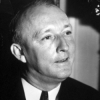
Hugo Black
Hugo Lafayette Blackwas an American politician and jurist. A member of the Democratic Party, Black represented Alabama in the United States Senate from 1927 to 1937, and served as an Associate Justice of the Supreme Court of the United States from 1937 to 1971. Black was nominated to the Supreme Court by President Franklin D. Roosevelt and confirmed by the Senate by a vote of 63 to 16He was first of nine Roosevelt nominees to the Court, and he outlasted...
NationalityAmerican
ProfessionSupreme Court Justice
Date of Birth27 February 1886
CountryUnited States of America
No higher duty, or more solemn responsibility, rests upon this Court than that of translating into living law and maintaining this constitutional shield deliberately planned and inscribed for the benefit of every human being subject to our Constitution-of whatever race, creed or persuasion.
The public welfare demands that constitutional cases must be decided according to the terms of the Constitution itself, and not according to judges views of fairness, reasonableness, or justice. I have no fear of constitutional amendments properly adopted, but I do fear the rewriting of the Constitution by judges under the guise of interpretation.
When I was 40, my doctor advised me that a man in his 40s shouldn't play tennis. I heeded his advice carefully and could hardly wait until I reached 50 to start again.
The Framers of the Constitution knew that free speech is the friend of change and revolution. But they also knew that it is always the deadliest enemy of tyranny.
The Press was protected so that it could bare the secrets of the government and inform the people. Only a free and unrestrained press can effectively expose deception in government. And paramount among the responsibilities of a free press is the duty to prevent any part of the government from deceiving the people.
The layman's constitutional view is that what he likes is constitutional and that which he doesn't like is unconstitutional.
An unconditional right to say what one pleases about public affairs is what I consider to be the minimum guarantee of the First Amendment.
Freedom of speech means that you shall not do something to people either for the views they have, or the views they express, or the words they speak or write.
I cannot agree with those who think of the Bill of Rights as an 18th century straitjacket, unsuited for this age...The evils it guards against are not only old, they are with us now, they exist today.
Only a free and unrestrained press can effectively expose deception in government.
The First Amendment's language leaves no room for inference that abridgments of speech and press can be made just because they are slight. That Amendment provides, in simple words, that "Congress shall make no law . . . abridging the freedom of speech, or of the press." I read "no law . . . abridging" to mean no law abridging.
There can be no equal justice where the kind of trial a man gets depends on the amount of money he has.
A union of government and religion tends to destroy government and degrade religion.
The First Amendment was added to the Constitution to stand as a guarantee that neither the power nor the prestige of the Federal Government would be used to control, support or influence the kinds of prayer the American people can say - that the peop