Hugo Black
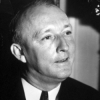
Hugo Black
Hugo Lafayette Blackwas an American politician and jurist. A member of the Democratic Party, Black represented Alabama in the United States Senate from 1927 to 1937, and served as an Associate Justice of the Supreme Court of the United States from 1937 to 1971. Black was nominated to the Supreme Court by President Franklin D. Roosevelt and confirmed by the Senate by a vote of 63 to 16He was first of nine Roosevelt nominees to the Court, and he outlasted...
NationalityAmerican
ProfessionSupreme Court Justice
Date of Birth27 February 1886
CountryUnited States of America
That Amendment requires the state to be a neutral in its relations with groups of religious believers and nonbelievers; it does not require the state to be their adversary. State power is no more to be used so as to handicap religions than it is to favor them.
No tax in any amount, large or small, can be levied to support any religious activities or institutions, whatever they may be called, or whatever form they may adopt to teach or practice religion.
When the power, prestige, and financial support of government is placed behind a particular religious belief, the indirect coercive pressure upon religious minorities to conform to the prevailing officially approved religion is plain.
The First Amendment has erected a wall between church and state. That wall must be kept high and impregnable. We could not approve the slightest breach. [Progressive]
No person can be punished for entertaining or professing religious beliefs or disbeliefs, for church attendance or nonattendance.
It is the paradox of life that the way to miss pleasure is to seek it first. The very first condition of lasting happiness is that a life should be full of purpose, aiming at something outside self.
Chief justices come and go, ... Some are more influential than others because they are greater lawyers. Sometimes chief justices are more influential than others because they have a talent for that.
Sex is a fact of life...and while it may lead to abuses...no words need be spoken...for people to know that the subject is one pleasantly interwoven in all human activities and involves the very substance of creation itself.
[I]t is true that [the provisions of the Bill of Rights] were designed to meet ancient evils. But they are the same kind of human evils that have emerged from century to century whenever excessive power is sought by the few at the expense of the many.
The First Amendment provides the only kind of security system that can preserve a free government - one that leaves the way wide open for people to favor, discuss, advocate, or incite causes and doctrines however obnoxious and antagonistic such views may be to the rest of us.
The lesson which wars and depressions have taught is that if we want peace, prosperity and happiness at home we must help to establish them abroad.
The Founding Fathers gave the free press the protection it must have to bare the secrets of government and inform the people.
The "establishment of religion" clause of the First Amendment means at least this: Neither a state nor the Federal Government can set up a church. Neither can pass laws which aid one religion, aid all religions, or prefer one religion over another. Neither can force nor influence a person to go to or to remain away from church against his will or force him to profess a belief or disbelief in any religion.
Freedom to publish means freedom for all and not for some. Freedom to publish is guaranteed by the constitution but freedom to continue to prevent others from publishing is not.