Immanuel Kant
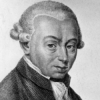
Immanuel Kant
Immanuel Kantwas a German philosopher who is considered the central figure of modern philosophy. Kant argued that fundamental concepts of the human mind structure human experience, that reason is the source of morality, that aesthetics arises from a faculty of disinterested judgment, that space and time are forms of our sensibility, and that the world as it is "in-itself" is unknowable. Kant took himself to have effected a Copernican revolution in philosophy, akin to Copernicus' reversal of the age-old belief...
NationalityGerman
ProfessionPhilosopher
Date of Birth22 April 1724
CountryGermany
Intuition and concepts constitute... the elements of all our knowledge, so that neither concepts without an intuition in some way corresponding to them, nor intuition without concepts, can yield knowledge.
Freedom in the practical sense is the independence of the power of choice from necessitation by impulses of sensibility
[S]uppose the mind of [a] friend of humanity were clouded over with his own grief, extinguishing all sympathetic participation in the fate of others; he still has the resources to be beneficent to those suffering distress, but the distress of others does not touch him because he is sufficiently busy with his own; and now, where no inclination any longer stimulates him to it, he tears himself out of his deadly insensibility and does the action without any inclination, solely from duty.
The ultimate destiny of the human race is the greatest moral perfection, provided that it is achieved through human freedom, whereby alone man is capable of the greatest happiness.
That Logic has advanced in this sure course, even from the earliest times, is apparent from the fact that, since Aristotle, it has been unable to advance a step, and thus to all appearance has reached its completion.
The question is not so much whether there is life on Mars as whether it will continue to be possible to live on Earth
Riches ennoble a man's circumstances, but not himself.
Beneficence is a duty; and he who frequently practices it, and sees his benevolent intentions realized comes, at length, really to love him to whom he has done good.
Animals... are there merely as a means to an end. That end is man.
The business of philosophy is not to give rules, but to analyze the private judgments of common reason.
This can never become popular, and, indeed, has no occasion to be so; for fine-spun arguments in favour of useful truths make just as little impression on the public mind as the equally subtle objections brought against these truths. On the other hand, since both inevitably force themselves on every man who rises to the height of speculation, it becomes the manifest duty of the schools to enter upon a thorough investigation of the rights of speculative reason, and thus to prevent the scandal which metaphysical controversies are sure, sooner or later, to cause even to the masses.
Upon the solution of this problem, or upon sufficient proof of the impossibility of synthetical knowledge a priori, depends the existence or downfall of metaphysics.
Here I shall add that the concept of change, and with it the concept of motion, as change of place, is possible only through and in the representation of time. & Motion, for example, presupposes the perception of something movable. But space considered in itself contains nothing movable; consequently motion must be something which is found in space only through experience -in other words, is an empirical datum.
The inscrutable wisdom through which we exist is not less worthy of veneration in respect to what it denies us than in respect to what it has granted.