Immanuel Kant
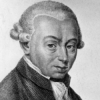
Immanuel Kant
Immanuel Kantwas a German philosopher who is considered the central figure of modern philosophy. Kant argued that fundamental concepts of the human mind structure human experience, that reason is the source of morality, that aesthetics arises from a faculty of disinterested judgment, that space and time are forms of our sensibility, and that the world as it is "in-itself" is unknowable. Kant took himself to have effected a Copernican revolution in philosophy, akin to Copernicus' reversal of the age-old belief...
NationalityGerman
ProfessionPhilosopher
Date of Birth22 April 1724
CountryGermany
Enlightenment is man's emergence from his self-imposed immaturity...No thing is required for this enlightenment.. .except freedom; and the freedom in question is the least harmful of all, namely, the freedom to use reason publicly in all matters.
Men will not understand … that when they fulfil their duties to men, they fulfil thereby God's commandments; that they are consequently always in the service of God, as long as their actions are moral, and that it is absolutely impossible to serve God otherwise.
The greatest problem for the human species, the solution of which nature compels him to seek, is that of attaining a civil society which can administer justice universally.
Perpetual Peace is only found in the graveyard.
Human reason has the peculiar fate ... that it is burdened with questions that it cannot dismiss ... but which it also cannot answer.
It is presumed that there exists a great unity in nature, in respect of the adequacy of a single cause to account for many different kinds of consequences.
Thoughts without content are empty, intuitions without concepts are blind... The understanding can intuit nothing, the senses can think nothing. Only through their union can knowledge arise.
Our knowledge springs from two fundamental sources of the mind; the first is the capacity of receiving representations (receptivity for impressions), the second is the power of knowing an object through these representations (spontaneity [in the production] of concepts).
We come no nearer the infinitude of the creative power of God, if we enclose the space of its revelation within a sphere described with the radius of the Milky Way, than if we were to limit it to a ball an inch in diameter. All that is finite, whatever has limits and a definite relation to unity, is equally far removed from the infinite... Eternity is not sufficient to embrace the manifestations of the Supreme Being, if it is not combined with the infinitude of space.
The ideal of the supreme being is nothing but a regulative principle of reason which directs us to look upon all connection in the world as if it originated from an all-sufficient necessary cause.
Man desired concord; but nature knows better what is good for his species; she desires discord. Man wants to live easy and content; but nature compels him to leave ease... and throw himself into roils and labors.
Reason must approach nature with the view, indeed, of receiving information from it, not, however, in the character of a pupil, who listens to all that his master chooses to tell him, but in that of a judge, who compels the witnesses to reply to those questions which he himself thinks fit to propose. To this single idea must the revolution be ascribed, by which, after groping in the dark for so many centuries, natural science was at length conducted into the path of certain progress.
It is the Land of Truth (enchanted name!), surrounded by a wide and stormy ocean, the true home of illusion, where many a fog bank and ice, that soon melts away, tempt us to believe in new lands, while constantly deceiving the adventurous mariner with vain hopes, and involving him in adventures which he can never leave, yet never bring to an end.
Nothing is divine but what is agreeable to reason.