Immanuel Kant
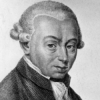
Immanuel Kant
Immanuel Kantwas a German philosopher who is considered the central figure of modern philosophy. Kant argued that fundamental concepts of the human mind structure human experience, that reason is the source of morality, that aesthetics arises from a faculty of disinterested judgment, that space and time are forms of our sensibility, and that the world as it is "in-itself" is unknowable. Kant took himself to have effected a Copernican revolution in philosophy, akin to Copernicus' reversal of the age-old belief...
NationalityGerman
ProfessionPhilosopher
Date of Birth22 April 1724
CountryGermany
In the mere concept of one thing it cannot be found any character of its existence.
Heaven has given human beings three things to balance the odds of life: hope, sleep, and laughter.
If we knew that god exists, such knowledge would make morality impossible. For, if we acted morally from fear or fright, or confident of a reward, then this would not be moral. It would be enlightened selfishness.
Enlightenment is man's emergence from his self-incurred immaturity.
The busier we are, the more acutely we feel that we live, the more conscious we are of life.
The light dove, in free flight cutting through the air the resistance of which it feels, could get the idea that it could do even better in airless space. Likewise, Plato abandoned the world of the senses because it posed so many hindrances for the understanding, and dared to go beyond it on the wings of the ideas, in the empty space of pure understanding.
Two things fill the mind with ever new and increasing admiration and awe, the more often and steadily we reflect upon them: the starry heavens above me and the moral law within me. I do not seek or conjecture either of them as if they were veiled obscurities or extravagances beyond the horizon of my vision; I see them before me and connect them immediately with the consciousness of my existence."
The only objects of practical reason are therefore those of good and evil. For by the former is meant an object necessarily desired according to a principle of reason; by the latter one necessarily shunned, also according to a principle of reason.
All thought must, directly or indirectly, by way of certain characters, relate ultimately to intuitions, and therefore, with us, to sensibility, because in no other way can an object be given to us.
Prudence reproaches; conscience accuses.
So act that anything you do may become universal law.
The only thing that is good without qualification is a good will.
To be beneficent when we can is a duty; and besides this, there are many minds so sympathetically constituted that, without any other motive of vanity or self-interest, they find a pleasure in spreading joy around them, and can take delight in the satisfaction of others so far as it is their own work. But I maintain that in such a case an action of this kind, however proper, however amiable it may be, has nevertheless no true moral worth, but is on a level with other inclinations. . . . For the maxim lacks the moral import, namely, that such actions be done from duty, not from inclination.
Deaths, births, and marriages, considering how much they are separately dependent on the freedom of the human will, should seem to be subject to no law according to which any calculation could be made beforehand of their amount; and yet the yearly registers of these events in great countries prove that they go on with as much conformity to the laws of nature as the oscillations of the weather.