Immanuel Kant
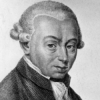
Immanuel Kant
Immanuel Kantwas a German philosopher who is considered the central figure of modern philosophy. Kant argued that fundamental concepts of the human mind structure human experience, that reason is the source of morality, that aesthetics arises from a faculty of disinterested judgment, that space and time are forms of our sensibility, and that the world as it is "in-itself" is unknowable. Kant took himself to have effected a Copernican revolution in philosophy, akin to Copernicus' reversal of the age-old belief...
NationalityGerman
ProfessionPhilosopher
Date of Birth22 April 1724
CountryGermany
The desire of a man for a woman is not directed at her because she is a human being, but because she is a woman. That she is a human being is of no concern to him.
A science of all these possible kinds of space [the higher dimensional ones] would undoubtedly be the highest enterprise which a finite understanding could undertake in the field of geometry... If it is possible that there could be regions with other dimensions, it is very likely that God has somewhere brought them into being.
In man (as the only rational creature on earth) those natural capacities which are directed to the use of his reason are to be fully developed only in the race, not in the individual.
The function of the true state is to impose the minimum restrictions and safeguard the maximum liberties of the people, and it never regards the person as a thing.
What are the aims which are at the same time duties? They are perfecting of ourselves, the happiness of others.
...as soon as we examine suicide from the standpoint of religion we immediately see it in its true light. We have been placed in this world under certain conditions and for specific purposes. But a suicide opposes the purpose of his creator; he arrives in the other world as one who has deserted his post; he must be looked upon as a rebel against God. God is our owner; we are his property; his providence works for our good.
Suicide is not abominable because God prohibits it; God prohibits it because it is abominable.
Prudence approaches, conscience accuses.
The infinitude of creation is great enough to make a world, or a Milky Way of worlds, look in comparison with it what a flower or an insect does in comparison with the Earth.
He who has made great moral progress ceases to pray
God, freedom, and immortality are untenable in the light of pure reason.
Physicians think they are doing something for you by labeling what you have as a disease
Beauty presents an indeterminate concept of Understanding, the sublime an indeterminate concept of Reason.
Human reason has this peculiar fate that in one species of its knowledge it is burdened by questions which, as prescribed by the very nature of reason itself, it is not able to ignore, but which, as transcending all its powers, it is also not able to answer.