Nhat Hanh
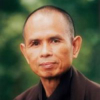
Nhat Hanh
Thích Nhất Hạnh; born as Nguyen Xuan Bao on October 11, 1926) is a Vietnamese Buddhist monk and peace activist. He lives in Plum Village in the Dordogne region in the south of France, travelling internationally to give retreats and talks. He coined the term "Engaged Buddhism" in his book Vietnam: Lotus in a Sea of Fire. A long-term exile, he was given permission to make his first return trip to Vietnam in 2005...
NationalityVietnamese
ProfessionActivist
Date of Birth11 October 1926
CountryVietnam
May we awaken from forgetfulness and realize our true home.
The healing of ourselves is the healing of the whole nation. Society is only a manifestation of our collective consciousness and our collective consciousness has a lot of fear, violence and hatred in it. ... It is possible to transform our heart...Not much time is needed...(the transformation can be born) the moment you vow to go in the direction of peace and service.
The organic gardener does not think of throwing away the garbage. She knows that she needs the garbage. She is capable of transforming the garbage into compost, so that the compost can turn into lettuce, cucumber, radishes, and flowers again...With the energy of mindfulness, you can look into the garbage and say: I am not afraid. I am capable of transforming the garbage back into love.
Our role as gardeners is to choose, plant and tend the best seeds within the garden of our consciousness. Learning to look deeply at our consciousness is our greatest gift and our greatest need, for there lie the seeds of suffering and of love, the very roots of our being, of who we are. Mindfulness...is the guide and the practice by which we learn how to use the seeds of suffering to nourish the seeds of love.
If you come to Plum Village in the summertime, you see many lotus flowers. Without the mud the lotus flowers cannot grow. You cannot separate lotus flowers from the mud. It is the same with understanding and love. These are two kinds of flowers that grow on the ground of suffering
All violence is injustice. Responding to violence with violence is injustice, not only to the other person but also to oneself. Responding to violence with violence resolves nothing; it only escalates violence, anger and hatred. It is only with compassion that we can embrace and disintegrate violence. This is true in relationships between individuals as well as in relationships between nations.
We all need a place that is safe and wholesome enough for us to return for refuge. In Buddhism, that refuge is mindfulness.
I vow to live fully in each moment.
Mindful consumption is the object of this precept. We are what we consume. If we look deeply into the items that we consume every day, we will come to know our own nature very well. We have to eat, drink, consume, but if we do it unmindfully, we may destroy our bodies and our consciousness, showing ingratitude toward our ancestors, our parents, and future generations.
Let us look at wealth and poverty. The affluent society and the deprived society inter-are. The wealth of one society is made of the poverty of the other. "This is like this, because that is like that." Wealth is made of non-wealth elements, and poverty is made by non-poverty elements. [...] so we must be careful not to imprison ourselves in concepts. The truth is that everything contains everything else. We cannot just be, we can only inter-be. We are responsible fo everything that happens around us.
You must be completely awake in the present to enjoy the tea.
To develop understanding, you have to practice looking at all living things with the eyes of compassion.
Human beings are not our enemy. Our enemy is not the other person. Our enemy is the violence, ignorance, and injustice in us and in the other person. When we are armed with compassion and understanding, we fight not against other people, but against the tendency to invade, to dominate, and to exploit.
We have a lamp inside us. The oil of that lamp is our breathing, our steps, and our peaceful smile. Our practice is to light up the lamp.