Nhat Hanh
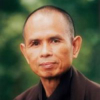
Nhat Hanh
Thích Nhất Hạnh; born as Nguyen Xuan Bao on October 11, 1926) is a Vietnamese Buddhist monk and peace activist. He lives in Plum Village in the Dordogne region in the south of France, travelling internationally to give retreats and talks. He coined the term "Engaged Buddhism" in his book Vietnam: Lotus in a Sea of Fire. A long-term exile, he was given permission to make his first return trip to Vietnam in 2005...
NationalityVietnamese
ProfessionActivist
Date of Birth11 October 1926
CountryVietnam
When we hug, our hearts connect and we know that we are not separate beings. Hugging with mindfulness and concentration can bring reconciliation, healing, understanding, and much happiness.
It is possible to live happily in the here and now. So many conditions of happiness are available-more than enough for you to be happy right now. You don't have to run into the future in order to get more.
Buddhism teaches us not to try to run away from suffering. You have to confront suffering. You have to look deeply into the nature of suffering in order to recognize its cause, the making of the suffering.
This is a very important practice. Live your daily life in a way that you never lose yourself. When you are carried away with your worries, fears, cravings, anger, and desire, you run away from yourself and you lose yourself. The practice is always to go back to oneself.
There is no real separation between self or no-self. Anything you do for yourself you do for the society at the same time. And anything you do for society you do for yourself also.
Each breath we take, each step we make, each smile we realize, is a positive contribution to peace... a necessary step in the direction of peace for the world.
In mindfulness one is not only restful and happy, but alert and awake. Meditation is not evasion; it is a serene encounter with reality.
There is no birth, there is no death; there is no coming, there is no going; there is no same, there is no different; there is no permanent self, there is no annihilation. We only think there is.
There may be a time when a country will have to wake up from a vision of happiness, when they have to realize that theirs is not the perfect idea, that there are many aspects that do not correspond to the reality of what is there, the real need and aspirations of the people.
The past is gone, the future is not yet here, and if we do not go back to ourselves in the present moment, we cannot be in touch with life.
Meditation is not meant to help us avoid problems or run away from difficulties. It is meant to allow positive healing to take place. To meditate is to learn how to stop—to stop being carried away by our regrets about the past, our anger or despair in the present, or our worries about the future.
A summer breeze can be very refreshing; but if we try to put it in a tin can so we can have it entirely to ourselves, the breeze will die. Our beloved is the same. He is like a breeze, a cloud, a flower. If you imprison him in a tin can, he will die. Yet many people do just that. They rob their loved one of his liberty, until he can no longer be himself. They live to satisfy themselves and use their loved one to help them fulfill that. That is not loving; it is destroying.
We are looking for happiness and running after it in such a way that creates anger, fear and discrimination. So when you attend a retreat, you have a chance to look at the deep roots of this pollution of the collective energy that is unwholesome.
It is not a matter of faith, it is a matter of practice