Samuel Johnson
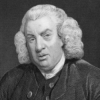
Samuel Johnson
Samuel Johnson, often referred to as Dr Johnson, was an English writer who made lasting contributions to English literature as a poet, essayist, moralist, literary critic, biographer, editor and lexicographer. Johnson was a devout Anglican and committed Tory, and has been described as "arguably the most distinguished man of letters in English history". He is also the subject of "the most famous single biographical work in the whole of literature," James Boswell's Life of Samuel Johnson...
NationalityEnglish
ProfessionNon-Fiction Author
Date of Birth18 September 1709
The habit of looking on the best side of every event is worth more than a thousand pounds a years.
The happiest conversation is that of which nothing is distinctly remembered but a general effect of pleasing impression.
The greatest part of a writer's time is spent in reading, in order to write; a man will turn over half a library to make one book.
A mode of transferring property without producing any intermediate good
The drama's laws, the drama's patrons give, for we that live to please, must please to live.
Great works are performed not by strength but by perseverance.
It was not for me to bandy civilities with my Sovereign
That man (Lord Lyttelton) sat down to write a book, to tell the world what the world had all his life been telling him
That man is little to be envied whose patriotism would not gain force upon the plain of Marathon, or whose piety would not grow warmer among the ruins of Iona
It is common for controversists, in the heat of disputation, to add one position to another till they reach the extremities of knowledge, where truth and falsehood lose their distinction
It is difficult to conjecture, from the conduct of him whom we see in a low condition, how he would act if wealth and power were put into his hands
In youth, it is common to measure right and wrong by the opinion of the world, and in age, to act without any measure but interest, and to lose shame without substituting virtue.
Wickedness is always easier than virtue, for it takes a short cut to everything.
Knowledge is praised and desired by multitudes whom her charms could never rouse from the couch of sloth; whom the faintest invitation of pleasure draws away from their studies; to whom any other method of wearing the day is more eligible than the use of books, and who are more easily engaged by any conversation than such as may rectify their notions or enlarge their comprehension.