Samuel Johnson
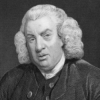
Samuel Johnson
Samuel Johnson, often referred to as Dr Johnson, was an English writer who made lasting contributions to English literature as a poet, essayist, moralist, literary critic, biographer, editor and lexicographer. Johnson was a devout Anglican and committed Tory, and has been described as "arguably the most distinguished man of letters in English history". He is also the subject of "the most famous single biographical work in the whole of literature," James Boswell's Life of Samuel Johnson...
NationalityEnglish
ProfessionNon-Fiction Author
Date of Birth18 September 1709
Many useful and valuable books lie buried in shops and libraries, unknown and unexamined, unless some lucky compiler opens them by chance, and finds an easy spoil of wit and learning.
The mind is seldom quickened to very vigorous operations but by pain, or the dread of pain. We do not disturb ourselves with the detection of fallacies which do us no harm.
[W]ith an unquiet mind, neither exercise, nor diet, nor physick can be of much use.
How many may a man of diffusive conversation count among his acquaintances, whose lives have been signalized by numberless escapes; who never cross the river but in a storm, or take a journey into the country without more adventures than befel the knights-errant of ancient times in pathless forests or enchanted castles! How many must he know, to whom portents and prodigies are of daily occurrence; and for whom nature is hourly working wonders invisible to every other eye, only to supply them with subjects of conversation?
Tradition is but a meteor, which, if it once falls, cannot be rekindled. Memory, once interrupted, is not to be recalled. But written learning is a fixed luminary, after the cloud that had hidden it has passed away, is again bright in its proper station. So books are faithful repositories, which may be awhile neglected or forgotten, but when opened again, will again impart instruction.
Books to judicious compilers, are useful; to particular arts and professions, they are absolutely necessary; to men of real science, they are tools: but more are tools to them.
Disappointment, when it involves neither shame nor loss, is as good as success; for it supplies as many images to the mind, and as many topics to the tongue.
In all pointed sentences, some degree of accuracy must be sacrificed to conciseness.
I do not see, Sir, that it is reasonable for a man to be angry at another, whom a woman has preferred to him; but angry he is, no doubt; and he is loath to be angry at himself.
They that have grown old in a single state are generally found to be morose, fretful and captious; tenacious of their own practices and maxims; soon offended by contradiction or negligence; and impatient of any association but with those that will watch their nod, and submit themselves to unlimited authority.
This is my history; like all other histories, a narrative of misery.
Dogs have not the power of comparing. A dog will take a small piece of meat as readily as a large, when both are before him.
Luncheon: as much food as one's hand can hold.
In questions of law or of fact conscience is very often confounded with opinion. No man's conscience can tell him the rights of another man; they must be known by rational investigation or historical inquiry.