Samuel Johnson
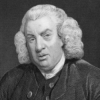
Samuel Johnson
Samuel Johnson, often referred to as Dr Johnson, was an English writer who made lasting contributions to English literature as a poet, essayist, moralist, literary critic, biographer, editor and lexicographer. Johnson was a devout Anglican and committed Tory, and has been described as "arguably the most distinguished man of letters in English history". He is also the subject of "the most famous single biographical work in the whole of literature," James Boswell's Life of Samuel Johnson...
NationalityEnglish
ProfessionNon-Fiction Author
Date of Birth18 September 1709
Friendship is not always the sequel of obligation....
Extended empires are like expanded gold, exchanging solid strength for feeble splendor.
Where secrecy or mystery begins, vice or roguery is not far off.
Sleep is a state in which a great part of every life is passed. No animal has yet been discovered, whose existence is not varied with intervals of insensibility; and some late philosophers have extended the empire of sleep over the vegetable world.
That is the happiest conversation where there is no competition, no vanity, but a calm, quiet interchange of sentiments....
As a madman is apt to think himself grown suddenly great, so he that grows suddenly great is apt to borrow a little from the madman.
Novelty is indeed necessary to preserve eagerness and alacrity; but art and nature have stores inexhaustible by human intellects, and every moment produces something new to him who has quickened his faculties by diligent observation.
It is as bad as bad can be: it is ill-fed, ill-killed, ill-kept, and ill-drest.
It is generally agreed, that few men are made better by affluence or exaltation.
Example is always more efficacious than precept.
The business of the poet, said Imlac, is to examine, not the individual, but the species.
Network. Anything reticulated or decussated at equal distances, with interstices between the intersections.
Memory is the primary and fundamental power, without which there could be no other intellectual operation.
Those who have past much of their lives in this great city, look upon its opulence and its multitudes, its extent and variety, with cold indifference; but an inhabitant of the remoter parts of the kingdom is immediately distinguished by a kind of dissipated curiosity, a busy endeavour to divide his attention amongst a thousand objects, and a wild confusion of astonishment and alarm.