Samuel Johnson
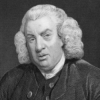
Samuel Johnson
Samuel Johnson, often referred to as Dr Johnson, was an English writer who made lasting contributions to English literature as a poet, essayist, moralist, literary critic, biographer, editor and lexicographer. Johnson was a devout Anglican and committed Tory, and has been described as "arguably the most distinguished man of letters in English history". He is also the subject of "the most famous single biographical work in the whole of literature," James Boswell's Life of Samuel Johnson...
NationalityEnglish
ProfessionNon-Fiction Author
Date of Birth18 September 1709
A man who is good enough to go to heaven is not good enough to be a clergyman.
He that outlives a wife whom he has long loved, sees himself disjoined from the only mind that has the same hopes, and fears, and interest; from the only companion with whom he has shared much good and evil; and with whom he could set his mind at liberty, to retrace the past or anticipate the future. The continuity of being is lacerated; the settled course of sentiment and action is stopped; and life stands suspended and motionless.
Never, my dear Sir, do you take it into your head that I do not love you; you may settle yourself in full confidence both of my love and my esteem; I love you as a kind man, I value you as a worthy man, and hope in time to reverence you as a man of exemplary piety.
There is no wisdom in useless and hopeless sorrow, but there is something in it so like virtue, that he who is wholly without it cannot be loved.
We love to overlook the boundaries which we do not wish to pass.
Every quotation contributes something to the stability or enlargement of language.
I am not yet so lost in lexicography, as to forget that words are the daughters of the earth, and that things are the sons of heaven. Language is only the instrument of science, and words are but the signs of ideas: I wish, however, that the instrument might be less apt to decay, and that signs might be permanent, like the things which they denote.
To use two languages familiarly and without contaminating one by the other, is very difficult; and to use more than two is hardly to be hoped. The prizes which some have received for their multiplicity of languages may be sufficient to excite industry, but can hardly generate confidence.
Truth, Sir, is a cow which will yield such people no more milk, and so they are gone to milk the bull.
The morality of an action depends on the motive from which we act. If I fling half a crown to a beggar with intention to break his head and he picks it up and buy victuals with it, the physical effect is good. But with respect to me the action is very wrong.
Sir, he [Bolingbroke] was a scoundrel and a coward: a scoundrel for charging a blunderbuss against religion and morality; a coward, because he had not resolution to fire it off himself, but left half a crown to a beggarly Scotsman to draw the trigger at his death.
If one was to think constantly of death, the business of life would stand still
What provokes your risibility, Sir? Have I said anything that you understand? Then I ask pardon of the rest of the company.
That man is never happy for the present is so true, that all his relief from unhappiness is only forgetting himself for a little while. Life is a progress from want to want, not from enjoyment to enjoyment.