Samuel Johnson
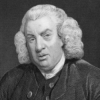
Samuel Johnson
Samuel Johnson, often referred to as Dr Johnson, was an English writer who made lasting contributions to English literature as a poet, essayist, moralist, literary critic, biographer, editor and lexicographer. Johnson was a devout Anglican and committed Tory, and has been described as "arguably the most distinguished man of letters in English history". He is also the subject of "the most famous single biographical work in the whole of literature," James Boswell's Life of Samuel Johnson...
NationalityEnglish
ProfessionNon-Fiction Author
Date of Birth18 September 1709
He was so generally civil, that nobody thanked him for it.
Books without the knowledge of life are useless.
Hypocrisy is the necessary burden of villainy, affectation part of the chosen trappings of folly; the one completes a villain, the other only finishes a fop.
It is not uncommon to charge the difference between promise and performance, between profession and reality, upon deep design and studied deceit; but the truth is, that there is very little hypocrisy in the world.
If a man could say nothing against a character but what he can prove, history could not be written.
A man may be very sincere in good principles, without having good practice.
The fiction of happiness is propagated by every tongue and confirmed by every look till at last all profess the joy which they do not feel and consent to yield to the general delusion.
Happiness is enjoyed only in proportion as it is known; and such is the state or folly of man, that it is known only by experience of its contrary.
Flattery pleases very generally. In the first place, the flatterer may think what he says to be true; but, in the second place, whether he thinks so or not, he certainly thinks those whom he flatters of consequence enough to be flattered.
It is necessary to the success of flattery, that it be accommodated to particular circumstances or characters, and enter the heart on that side where the passions are ready to receive it.
Men have solicitude about fame; and the greater share they have of it, the more afraid they are of losing it.
Be not too hasty to trust or to admire the teachers of morality; they discourse like angels, but they live like men.
Long customs are not easily broken; he that attempts to change the course of his own life very often labors in vain; and how shall we do that for others, which we are seldom able to do for ourselves.
The ambition of superior sensibility and superior eloquence disposes the lovers of arts to receive rapture at one time, and communicate it at another; and each labors first to impose upon himself and then to propagate the imposture.